

TL;DR:
- Quartz watches are more accurate but automatics offer greater personalization and craftsmanship.
- Modern high-end mechanical movements are reaching accuracy levels close to quartz standards.
- Hybrid movements combine mechanical or automatic features with electronic regulation for reliability and precision.
Most people assume quartz watches always beat mechanical ones for accuracy. That’s mostly true, but the gap is narrowing fast. Quartz movements vibrate a crystal at 32,768 Hz, delivering accuracy of ±10–15 seconds per month. Meanwhile, high-end mechanical movements certified under COSC Excellence now reach ±2 to +4 seconds per day. The real story isn’t just about accuracy, though. It’s about what a movement means for how your watch feels, performs, and how much you can personalize it. Understanding movement types puts you in control of every build decision.
Table of Contents
- What is a watch movement and why does it matter?
- Mechanical, automatic, and quartz explained
- Hybrid movements: Bridging old and new
- Customizability and the enthusiast’s dilemma
- What most articles miss about movement types and customization
- Find your perfect movement with customizable watches
- Frequently asked questions
Key Takeaways
| Point | Details |
|---|---|
| Quartz is king for accuracy | Quartz movements outperform mechanicals in precision, needing little maintenance. |
| Automatics offer customization | Modular automatic movements like ETA and Sellita allow personal touches while preserving reliability. |
| Hybrids blend soul and science | Hybrid movements bridge mechanical feel and quartz-level accuracy for enthusiasts. |
| Movement choice impacts experience | Selecting a movement type shapes your daily satisfaction and how you personalize your watch. |
What is a watch movement and why does it matter?
A watch movement is the internal engine that drives everything you see on the dial. It moves the hands, powers complications like date windows or chronographs, and determines how the watch interacts with the world around it. Think of it as the difference between a car with a manual transmission and one with an automatic. Both get you there, but the experience is completely different.
Movements generally fall into four categories:
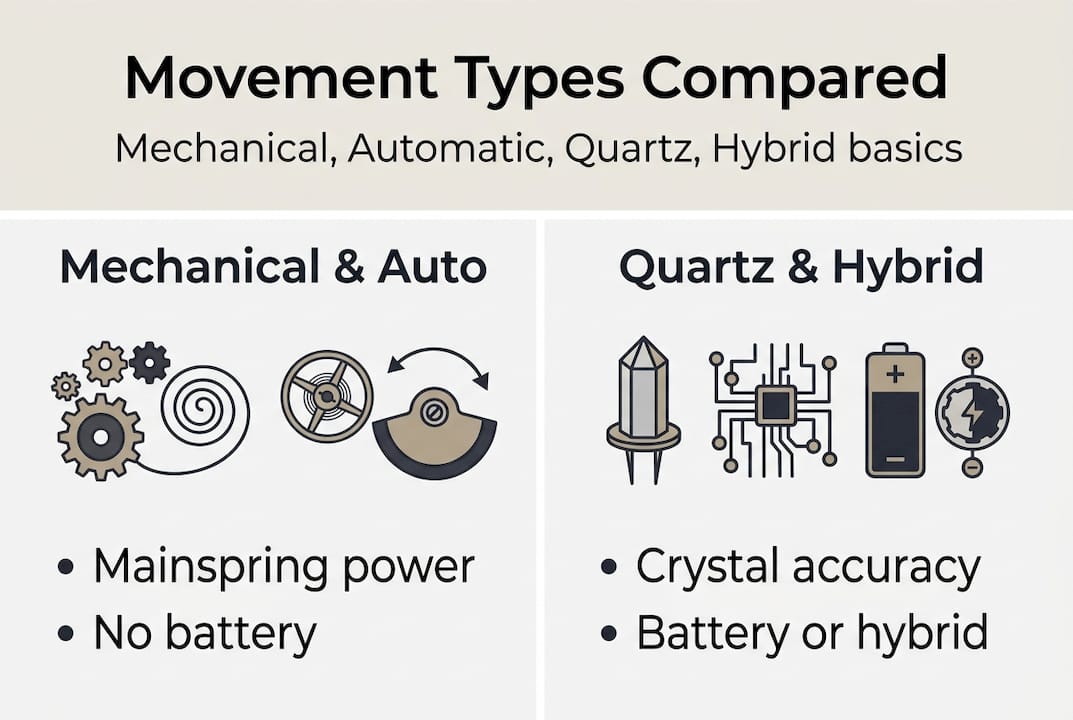
- Mechanical (manual wind): Powered by a mainspring you wind by hand. No battery needed. Requires regular winding.
- Automatic: A self-winding mechanical movement. A rotor spins as you move your wrist, keeping the mainspring tensioned.
- Quartz: Battery-powered. A quartz crystal oscillates at a precise frequency, driving a stepper motor to move the hands.
- Hybrid: Combines mechanical power sources with quartz-level regulation for the best of both worlds.
Movement choice directly affects accuracy, maintenance frequency, customization potential, and the overall feel of the watch on your wrist. If you’re interested in building your own watch, movement selection is one of the first and most important decisions you’ll make.
For enthusiasts focused on personalization, ETA and Sellita-based automatic movements offer modularity that makes swapping components and adding custom features far easier than with quartz calibers. That modularity is a big reason why the custom watch community gravitates toward automatics. Proper watch setup and care also becomes part of the ownership experience, which many enthusiasts genuinely enjoy.
Pro Tip: If you’re building a custom watch and want the most flexibility for personalization, start with a modular automatic movement like the NH35 or ETA 2824. These platforms have the widest range of compatible components available.
Mechanical, automatic, and quartz explained
Now that we understand the importance of movements, let’s dig into the main types and how they stack up in accuracy, artistry, and everyday practicality.
Mechanical movements are the oldest and most celebrated in horology. A coiled mainspring stores energy, releasing it through a series of gears and a balance wheel that oscillates back and forth. This oscillation controls the release of energy, moving the hands in that characteristic smooth sweep. You wind the mainspring manually, typically every 24 to 48 hours.
Automatic movements work on the same principle but add a rotor. As your wrist moves throughout the day, the rotor spins and winds the mainspring for you. Most enthusiasts prefer automatics for daily wear because they’re self-sustaining with normal use.
Quartz movements are powered by a battery that sends an electrical current through a quartz crystal. The crystal vibrates at exactly 32,768 Hz, and those vibrations are counted and converted into precise hand movements. The result is outstanding accuracy with almost zero maintenance.
Here’s how the three types compare directly:
| Feature | Mechanical | Automatic | Quartz |
|---|---|---|---|
| Accuracy | ±10–30 sec/day | ±5–30 sec/day | ±15 sec/month |
| Power source | Manual winding | Wrist movement | Battery |
| Maintenance | Service every 3–5 years | Service every 3–5 years | Battery every 1–3 years |
| Customization | High | Very high | Moderate |
| Artistry/appeal | Maximum | High | Functional |
COSC chronometer certification for mechanical movements requires a rate of -4/+6 seconds per day, tested over 15 days across 5 positions and 3 temperatures. That’s a rigorous standard. High-end mechanicals certified under the newer COSC Excellence program push even further, achieving ±2 to +4 seconds per day, closing the gap with quartz significantly.
“A COSC-certified mechanical watch isn’t just accurate. It’s a verified instrument, tested under conditions that mirror real-world wear.”
If you want to see how movement craftsmanship translates visually, open-heart watches give you a direct window into the oscillating components, making the movement itself part of the design.
Hybrid movements: Bridging old and new
Beyond traditional movement types lies a fascinating hybrid category that lets you enjoy mechanical craftsmanship without sacrificing quartz-level precision.
Hybrid movements solve a real problem. Mechanical movements are beautiful but demand attention. Quartz is accurate but lacks soul. Hybrids take the mechanical power source and regulate it with electronic precision.
The three most notable hybrid technologies are:
- Seiko Spring Drive: Uses a mainspring for power but regulates energy release through a Tri-synchro system. The result is a gliding seconds hand and accuracy of ±1 second per day, smoother than any traditional mechanical.
- Seiko Kinetic: A rotor generates electricity as you move, storing it in a capacitor that powers a quartz oscillator. No battery replacement needed, and quartz-level accuracy is maintained.
- Citizen Eco-Drive: Solar cells beneath the dial convert light into electricity, storing it in a capacitor. Accuracy matches standard quartz, and the watch can run for months in complete darkness on a full charge.
Here’s a quick breakdown of how these hybrids compare:
| Movement | Power source | Accuracy | Battery needed |
|---|---|---|---|
| Spring Drive | Mainspring | ±1 sec/day | No |
| Kinetic | Wrist movement | ±15 sec/month | No |
| Eco-Drive | Light/solar | ±15 sec/month | No |
Hybrids are an excellent option if you want the tactile satisfaction of a mechanical-style watch without the maintenance overhead. For guidance on keeping any of these running well, check out watch setup and care for practical tips.
Pro Tip: If you want a seconds hand that glides like butter instead of ticking, Spring Drive is the only movement that delivers that effect. It’s genuinely unlike anything else you’ll see on a watch.
Customizability and the enthusiast’s dilemma
With the mechanics and hybrid options covered, let’s discuss how real enthusiasts choose for customization, accuracy, and the elusive mechanical soul.
The honest truth is that movement choice shapes your entire customization experience. Quartz movements are compact and accurate, but they offer less room for modular upgrades and fewer compatible aftermarket components. Automatic movements, especially popular calibers, have entire ecosystems of parts built around them.
Here’s what to consider when choosing your movement for a custom build:
- Accuracy priority: Quartz wins for pure timekeeping. If you need to set it and forget it, quartz is the answer.
- Personalization priority: Automatic movements, particularly NH35 and ETA 2824 variants, offer the widest range of compatible dials, hands, rotors, and modules.
- Soul and experience: If you want to feel connected to your watch, the winding ritual and sweeping seconds hand of an automatic deliver that.
- Budget realism: Budget automatics like the DG2813 and NH35 can vary by ±30–40 seconds per day when unregulated, while refined movements like the ETA 2824 offer far tighter consistency.
Accuracy callout: Standard quartz runs at ±15 seconds per month. A regulated NH35 typically achieves ±10–15 seconds per day. An ETA 2824 in fine-adjusted state can reach ±5 seconds per day. The gap between budget and premium automatics is real and worth factoring into your build.
Customizing watch hands is one of the most impactful changes you can make to a build, and it pairs directly with your movement choice since hand fitment depends on the movement’s stem dimensions. When you’re ready to start building, the custom watch builder walks you through compatible components step by step.
The dilemma isn’t really mechanical vs. quartz. It’s about what kind of relationship you want with your watch.
What most articles miss about movement types and customization
Most content on this topic treats accuracy as the defining metric. Pick the most accurate movement, and you’ve made the right choice. That framing misses the point entirely for enthusiasts.
Accuracy matters, but it’s rarely the deciding factor for someone building a custom watch. What actually drives satisfaction is the combination of how a movement feels in daily use, how much you can personalize around it, and how it reflects your priorities as a collector.
Purists favor mechanical artistry despite the maintenance requirements and lower accuracy compared to quartz. Practical users lean toward hybrids and quartz for reliability. Both positions are valid. The new COSC Excellence standard is pushing high-end mechanicals closer to quartz benchmarks, which changes the conversation but doesn’t eliminate personal preference as the central factor.
Modular automatics are where customization really opens up. The ability to swap rotors, add complications, and choose compatible components from a large aftermarket ecosystem is something quartz simply can’t match at the same level. That modularity is the real argument for automatics in a custom build, not accuracy.
If you want to keep learning, explore more through our watch guides for deeper coverage of specific movements and build strategies.
Find your perfect movement with customizable watches
You now have a clear picture of how mechanical, automatic, quartz, and hybrid movements differ and what each one means for your build. The next step is putting that knowledge to work.
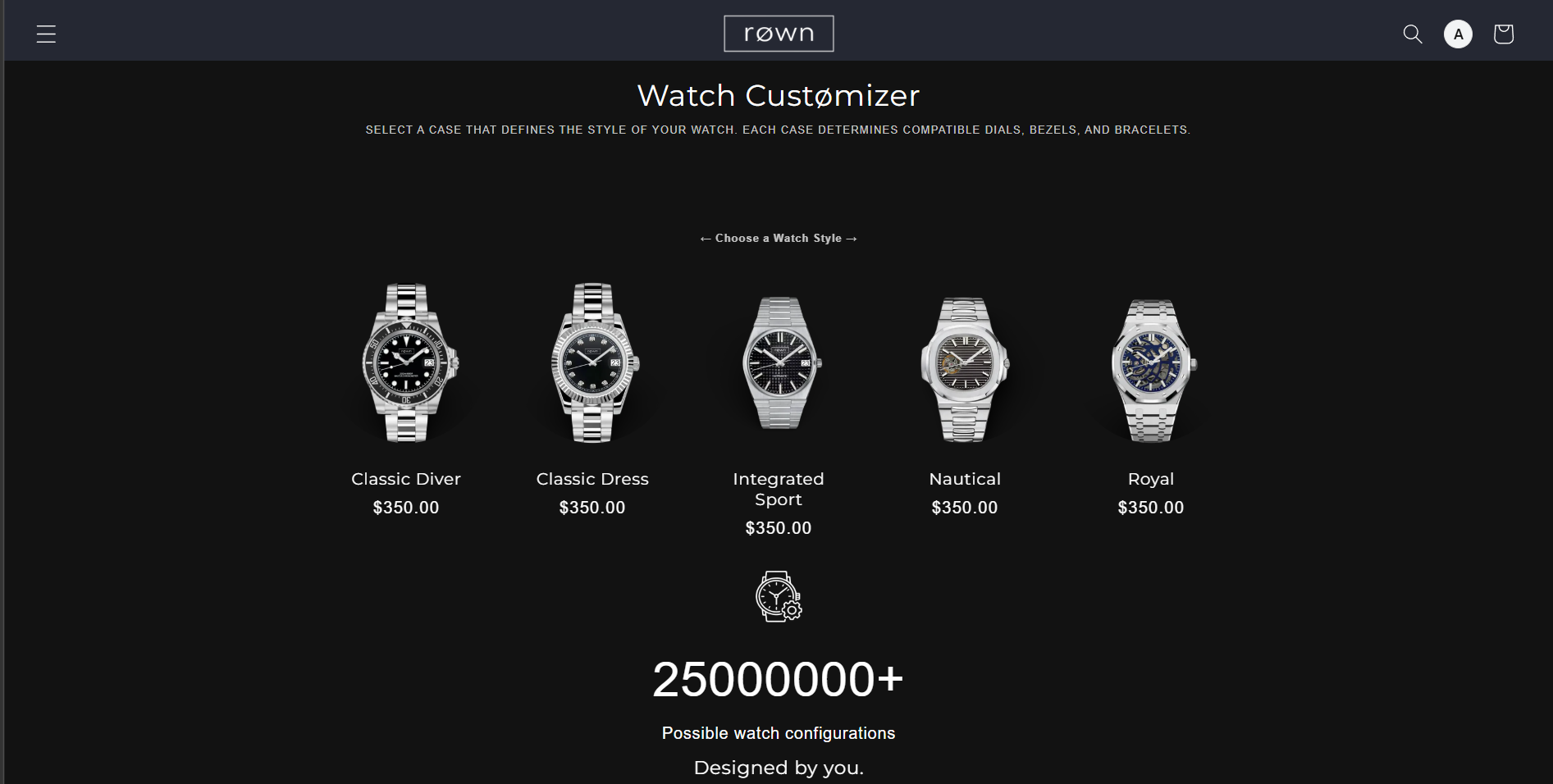
At røwn, you can explore men’s watches built around automatic movements with full customization options across dials, cases, bezels, and hands. If you want to go deep on personalization, the custom watch builder lets you configure every component to match your exact preferences. For something bold and purpose-built, the custom diver is a great starting point. Every build ships free, and our team stands behind the quality of every timepiece.
Frequently asked questions
Which watch movement is the most accurate?
Quartz movements are typically the most accurate, with standard models averaging ±15 seconds per month and high-precision types achieving ±5 seconds per year. Hybrid movements like Spring Drive close the gap significantly for mechanical fans.
Do automatic watches need battery replacement?
Automatic watches do not require batteries. They run on a mechanical mainspring that winds itself through wrist movement, and ETA and Sellita-based automatics are especially well-suited for long-term reliability without electrical power.
What are hybrid movements, and are they reliable?
Hybrid movements combine mechanical power with electronic regulation. Spring Drive achieves ±1 second per day accuracy, while Kinetic and Eco-Drive eliminate batteries entirely through motion or solar charging, making all three highly reliable for daily wear.
Can I customize my watch movement?
Yes. Automatic movements with modular designs, particularly ETA and Sellita platforms, are built for customization and support a wide range of compatible components, making them the top choice for enthusiasts who want a truly personalized timepiece.
Recommended
- Watch Setup & Care – røwn
- How to customize watch hands for a unique luxury look – røwn
- How to Build Your Own Watch | The #1 Ranked Custom Watch Builder by – røwn
- Open-heart watches: craftsmanship, style & buying guide – røwn
- Classic Wooden Men’s Mechanical Watch - STOMART.CO.UK