

TL;DR:
- Quartz watches are more accurate, low-maintenance, and durable than automatic watches.
- Automatics offer aesthetic appeal, mechanical appreciation, and better resale and heirloom value.
- Your choice depends on lifestyle, preference for craftsmanship, and desire for customization.
Not every luxury watch ticks the same way. Some of the most sought-after timepieces in the world run on quartz, yet many buyers assume that “luxury” always means mechanical. That assumption can lead you to the wrong watch. The real question isn’t which movement is objectively better. It’s which one fits how you live, what you value in a watch, and whether you plan to customize it. This guide breaks down how each movement works, how they perform in daily use, and how to match your choice to your personal style and long-term goals.
Table of Contents
- How automatic and quartz movements work
- Accuracy, maintenance, and durability compared
- Which should you choose? Style, customization, and lifestyle fit
- Investment, heirloom, and emotional value
- Why real-world watch lovers don’t settle for one movement
- Explore customizable luxury watches for your style
- Frequently asked questions
Key Takeaways
| Point | Details |
|---|---|
| Movement differences | Automatics are admired for tradition and motion; quartz is prized for precision and ease. |
| Daily wear factors | Choose quartz for low maintenance and accuracy, automatics for hands-on enjoyment. |
| Customization potential | Luxury automatics offer more room for bespoke designs and exclusive modifications. |
| Legacy and value | Automatics hold emotional and investment value, while quartz delivers practical reliability. |
How automatic and quartz movements work
Let’s first demystify how each movement works under the dial.
When you wear an automatic watch, your wrist motion powers it. A small weighted component called a rotor spins freely inside the case. As it rotates, it winds a coiled mainspring. That stored energy is then released gradually through a series of gears and a regulating device called the balance wheel. The balance wheel oscillates back and forth at a set frequency, controlling the release of energy in precise increments. This is what produces the smooth, sweeping motion of the seconds hand, the visual signature most people associate with a quality mechanical watch.
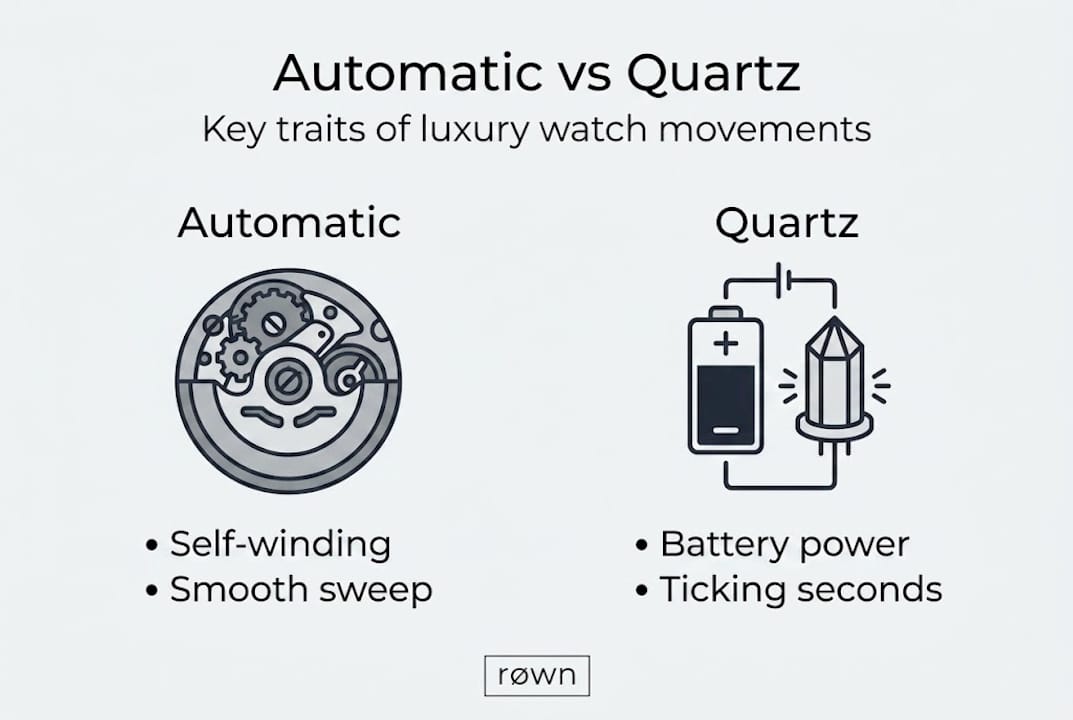
Automatic movements are self-winding via a rotor from wrist motion, storing energy in a mainspring and regulated by a balance wheel, which produces that smooth sweeping seconds hand. You can also wind most automatics manually through the crown if you haven’t worn the watch for a day or two and the mainspring runs low. Understanding all the watch movement types available helps you see where automatics fit within the broader landscape of horology.
Quartz is a very different story. A small battery sends an electrical current through a piece of synthetic quartz crystal. The crystal vibrates at exactly 32,768 times per second. An integrated circuit counts those vibrations and converts them into the precise one-second electrical pulses that move the stepper motor, which advances the seconds hand. This is why a quartz watch ticks with a clean, one-beat-per-second motion rather than a sweep.
Key differences at a glance:
- Automatic: No battery required, powered by wrist motion, sweeping seconds hand, regulated by a balance wheel
- Quartz: Battery powered, crystal oscillates at 32,768 Hz, ticking seconds hand, highly consistent accuracy
- Automatic power reserve: Typically 38 to 80 hours depending on the movement and mainspring capacity
- Quartz battery life: Usually 1 to 3 years, sometimes longer with eco-drive or solar charging variants
Quartz has fewer moving parts, higher shock resistance, and tolerates neglect far better than an automatic, which is more sensitive to shock, position changes, and temperature. If you set a quartz watch down for a month and come back to it, it will still be running accurately. An automatic left unworn for a few days will stop completely and need to be reset.
Pro Tip: If you own an automatic but don’t wear it every day, a watch winder is worth the investment. It rotates the watch on a motorized turntable to simulate wrist motion and keep the mainspring wound, so you’re never resetting the time and date when you pick it up.
The care experience between the two movements is genuinely different. Automatic watches reward regular wear. They become a small daily ritual. Quartz watches ask almost nothing of you in return for reliable performance. Neither approach is wrong. They just feel different to live with over time.
Accuracy, maintenance, and durability compared
Understanding the mechanics is essential. Now, let’s see how those differences affect performance in the real world.
Accuracy is often the first number people ask about, and quartz wins this comparison clearly. A standard quartz watch loses or gains roughly 15 seconds per month, which translates to about a minute or two per year. That level of consistency is possible because the quartz crystal’s 32,768 Hz vibration is extremely stable across normal temperature ranges.
Automatics are more variable. Standard automatic accuracy runs ±10 to 30 seconds per day, while a COSC-certified chronometer must meet a stricter standard of -4 to +6 seconds per day. High-end movements push further: Rolex Superlative Chronometer certification requires ±2 seconds per day, and the Breguet Classique 7225 reaches ±1 second per day. These are elite outliers. A solid everyday automatic from a respected brand will typically hold within ±10 to 15 seconds daily under normal conditions.
| Feature | Automatic | Quartz |
|---|---|---|
| Typical accuracy | ±10 to 30 sec/day | ±15 sec/month |
| Power source | Wrist motion / manual wind | Battery |
| Battery/service interval | Full service every 5 to 7 years | Battery change every 1 to 3 years |
| Shock resistance | Moderate, can be disrupted | High |
| Seconds hand motion | Smooth sweep | Clean tick |
| Maintenance complexity | Higher (skilled watchmaker needed) | Minimal |
Here’s a practical breakdown of how to think about maintenance over a 10-year period:
- Quartz: Replace the battery roughly every 2 years, keep the case and gaskets clean, and have the movement inspected every 5 to 7 years as preventative care.
- Automatic: Plan for a full service every 5 to 7 years. This includes disassembling the movement, cleaning every component, replacing worn parts, lubricating, and timing the watch. Expect to spend $200 to $800 or more depending on the brand and complexity.
- Both types: Pressure testing the water resistance seals every few years is recommended if you wear the watch near water.
Quartz is superior for accuracy, low maintenance, and shock resistance, making it ideal for daily reliability. Automatics earn their place through mechanical appreciation, the smooth sweep of the seconds hand, and heirloom value.
If you’re an active person, work in construction, outdoor adventure, or any environment with frequent impacts and vibrations, quartz holds up more predictably. The simplicity of its mechanism means fewer components to knock out of alignment. For reference, knowing how to properly care for your watch starts with setting your automatic watch correctly, especially after it’s been sitting unworn.
Durability for both types also depends heavily on the quality of the case, crystal, and gaskets. A well-made quartz watch in a solid stainless steel case will outlast a poorly built automatic every time. Movement type doesn’t guarantee longevity. Build quality does.
Which should you choose? Style, customization, and lifestyle fit
Performance is only part of the story. Your style, customization goals, and daily wear habits also matter significantly.
There’s a personality split between people who gravitate toward automatic watches and those who prefer quartz. It’s not absolute, but it’s real. If you enjoy the ritual of winding a watch, appreciate visible mechanical complexity through a skeleton case or exhibition caseback, and want a timepiece you can geek out on, automatics speak to that mindset naturally. If you want a watch that works precisely without any input from you, looks clean and modern, and stays on your wrist regardless of what you’re doing, quartz delivers that.
No movement is objectively better overall. Quartz suits precision tools and utility-focused watches. Automatics suit those who want interaction, craft, and a connection to the movement. Luxury hybrids exist, but mechanical movements remain the favored choice for deep customization.
The customization angle is important here. The world of bespoke watch building is built almost entirely around automatic movements. You can swap dials, hands, bezels, and bracelets across a wide range of compatible automatic calibers. The NH35, ETA 2824, and Miyota 9015 are common platforms that support extensive aftermarket customization. Quartz movements offer far less flexibility in this area. The joy of personalizing automatic watches comes from the depth of options available, not just the end result.
Consider these quick checklist questions before deciding:
- Do you wear a watch every single day? If yes, an automatic is a practical and rewarding choice.
- Do you rotate between multiple watches? A winder helps, but quartz handles long rests without any fuss.
- Is precision critical in your work? A pilot, surgeon, or anyone tracking time with high stakes may prefer quartz.
- Do you want to customize your watch? Automatics win here, nearly without contest.
- Are you buying as a gift? Quartz is easier to maintain for someone who isn’t a watch enthusiast.
Style-wise, automatics tend to pair well with dressier, more heritage-influenced aesthetics: clean dials, leather straps, polished cases. But they’re equally at home on a sport or diver design. Quartz watches often lean into bold, functional tool-watch territory, though plenty of luxury quartz pieces are highly refined and elegant.
Pro Tip: Look at your wardrobe and your calendar before you decide. If your typical week includes boardrooms and weekends outdoors, you may want one of each. There’s a reason style matching with watches is a real consideration for men who take their accessories seriously.
Investment, heirloom, and emotional value
Finally, let’s look beyond features and into the lasting value a watch can offer.
Watches have a unique capacity to carry emotional weight. Very few accessories get passed down through generations. A watch that belonged to your grandfather or father carries a story inside it, not just timekeeping mechanics. That story is almost always attached to a mechanical watch.
“The things we pass on are rarely the things we bought for utility. They’re the things we chose with intention, maintained with care, and wore through moments that mattered.”
Automatic watches occupy a different emotional space than quartz precisely because of the effort involved in owning one. You service them. You wind them. You learn their quirks. That relationship builds over years, sometimes decades. By the time an automatic watch passes from one owner to the next, it carries a lived-in quality that’s genuinely hard to replicate.
Automatics excel in mechanical appreciation, the smooth sweep of the seconds hand, and heirloom value. These are the qualities that make them meaningful beyond their function. A Rolex, Omega, or well-built custom automatic doesn’t just tell time. It holds its value financially and emotionally in ways that most quartz watches don’t.
That said, quartz watches aren’t without sentimental value. A quality quartz watch given as a graduation gift or a career milestone can absolutely be cherished. But the likelihood of it being serviced, maintained, and passed on the way a mechanical watch is? Statistically lower.
Key considerations for long-term value:
- Automatics tend to retain and appreciate in resale value, especially among recognized brands and limited editions.
- Quartz from entry-level or mid-tier brands often depreciates quickly, though high-end quartz from Grand Seiko or Longines holds up better.
- Customized automatics with documented build histories and quality components can become genuinely unique collector pieces.
- Both types benefit from careful storage, regular servicing, and original documentation when it comes to resale.
If you’re interested in the broader case for mechanical ownership, the prestige of automatic watches goes well beyond the movement itself. It’s about the craft tradition behind each component, and the choice to wear something made with intention.
Why real-world watch lovers don’t settle for one movement
Here’s an honest take: most serious watch enthusiasts own both. Not because they can’t decide, but because each movement genuinely fills a different need. The automatic goes on for dinners, weekend wear, and occasions that feel worth savoring. The quartz goes on when you’re traveling across time zones, doing physical work, or simply want something you don’t have to think about.
The idea that you need to pick one and commit for life is a misconception. Your tastes will evolve. The watch that appeals to you at 27 may not be the one you reach for at 34. Starting with an automatic to understand what the movement culture feels like, then adding a precision quartz when you need utility, is a natural progression. Exploring mechanical luxury design opens up a whole layer of appreciation that changes how you look at any watch on your wrist, regardless of what powers it. Give yourself permission to experiment. The “right” choice is the one you actually enjoy wearing.
Explore customizable luxury watches for your style
Now that you understand what separates automatic from quartz, you’re ready to start building something that’s actually yours.
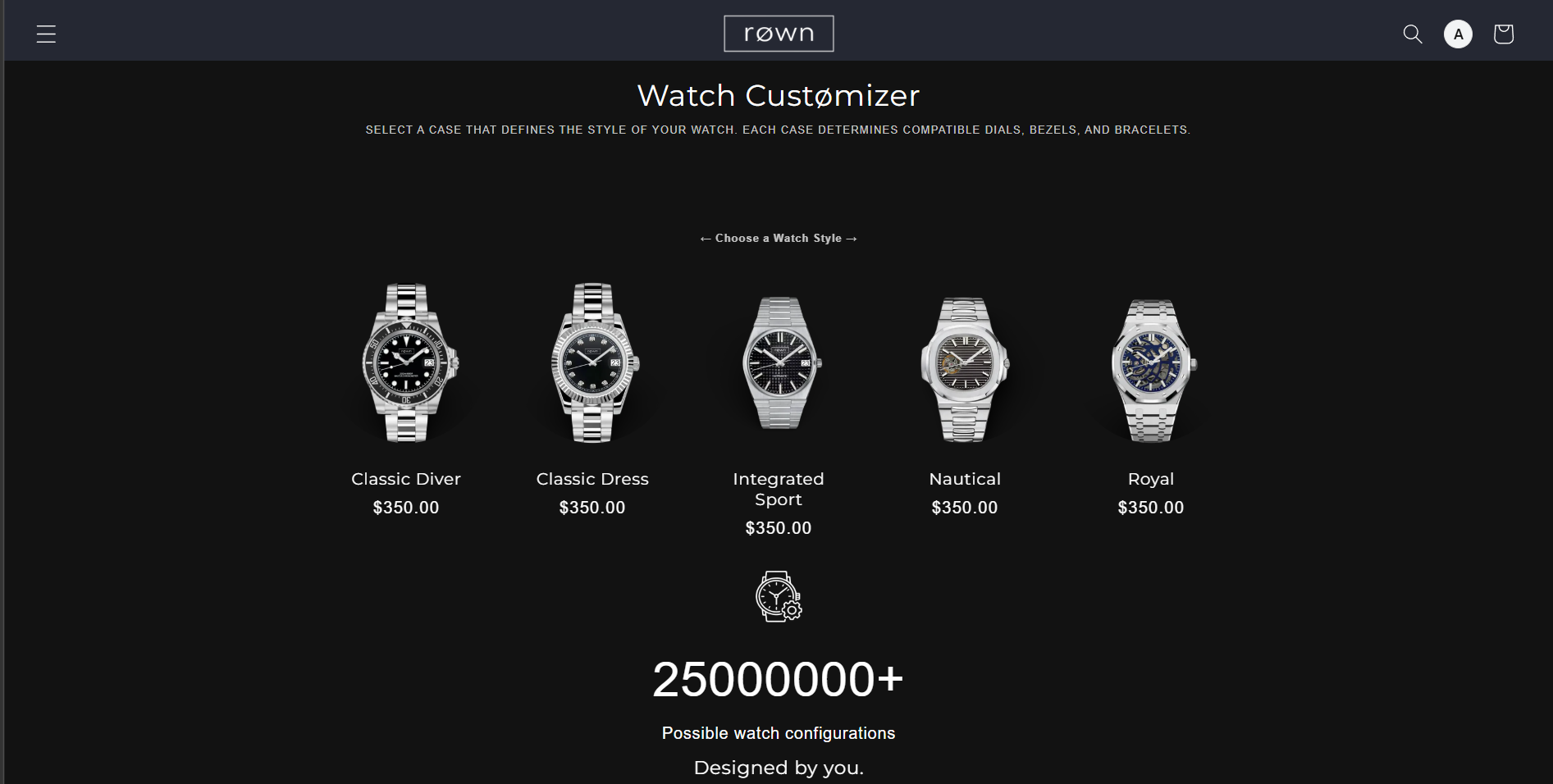
At Røwn, you’ll find men’s luxury watches across both movement categories, all designed with serious customization in mind. Whether you want the sweeping craftsmanship of an automatic or the precision consistency of quartz, the options are curated for men who care about what’s on their wrist. If you’re drawn toward the mechanical side, the custom diver model is a strong starting point, combining robust build quality with extensive personalization options for dial, bezel, and bracelet. Your next watch shouldn’t be a compromise. It should be exactly what you want.
Frequently asked questions
Are automatic watches more expensive than quartz?
Generally, automatic watches cost more due to the complexity of their mechanical movements and the craftsmanship required, but luxury quartz models from brands like Grand Seiko or TAG Heuer can also carry significant price tags.
How often should I service an automatic watch?
Most watchmakers recommend servicing automatics every 5 to 7 years, though more frequent servicing may be appropriate for watches worn daily in demanding conditions.
Do quartz watches require any maintenance?
Quartz watches tolerate neglect far better than automatics and mainly need a battery change every one to three years, with occasional case cleaning and gasket checks if worn near water.
Which movement is better for customizing a luxury watch?
Mechanical automatics are favored for customization because they support a wide range of compatible components across popular calibers, allowing for deep personalization of dials, bezels, hands, cases, and bracelets.