

TL;DR:
- Proper setting involves careful handling of the crown and adherence to specific procedures.
- Avoid setting the date during the danger zone (9pm to 3am) to prevent damage.
- Regular use and professional servicing help maintain accuracy and longevity of automatic watches.
Your luxury automatic watch shows the wrong time, and every time you glance at your wrist, that nagging inaccuracy chips away at your confidence in the piece. Setting it incorrectly is a real risk. One wrong move on the crown or one date change at the wrong hour can stress the movement and cause damage that’s expensive to repair. This guide walks you through exactly how to set your automatic watch accurately, from understanding the mechanism to verifying long-term accuracy. Follow these steps and you’ll handle your timepiece with the same care that went into building it.
Table of Contents
- Understanding your automatic watch movement
- Checklist: What you need before setting your watch
- Step-by-step: How to set your automatic watch
- Troubleshooting and avoiding common mistakes
- Verifying accuracy and maintaining your automatic watch
- Why most luxury watch owners overcomplicate the process
- Discover luxury customization and upgrade options
- Frequently asked questions
Key Takeaways
| Point | Details |
|---|---|
| Preparation is crucial | Gather the right tools and set up your workspace to avoid accidental damage during setup. |
| Follow a safe setting sequence | Always set time and date in the recommended order to protect delicate mechanisms. |
| Avoid common mistakes | Never set the date between 9pm and 3am, and use gentle, steady pressure on the crown. |
| Verify and maintain accuracy | Check your watch regularly for accurate timekeeping and schedule professional servicing when needed. |
Understanding your automatic watch movement
Before you touch the crown, you need to understand what’s actually happening inside your watch. Automatic watches are mechanical marvels. They don’t rely on a battery. Instead, automatic watches use kinetic energy from your natural wrist movement to wind themselves continuously.
The three core components you need to know:
- Rotor: A semicircular weight that spins as you move your wrist, transferring energy to the mainspring.
- Movement (caliber): The engine of the watch. It controls timekeeping, date display, and other complications.
- Crown: The small knob on the side of the case. You use it to set the time, date, and sometimes wind the watch manually.
Here’s how automatic compares to its main alternatives:
| Feature | Automatic | Manual | Quartz |
|---|---|---|---|
| Power source | Wrist movement | Manual winding | Battery |
| Accuracy | ±5 to ±25 sec/day | ±5 to ±25 sec/day | ±15 sec/month |
| Servicing needed | Every 3-5 years | Every 3-5 years | Battery replacement |
| Craftsmanship appeal | Very high | Very high | Low to moderate |
| Setting complexity | Moderate | Moderate | Simple |
Understanding the automatic vs manual watches distinction helps you appreciate why setting matters. Manual and automatic movements are precision instruments. Improper force on the crown or setting the date at the wrong time can strip small gears or bend delicate components inside.
“The beauty of automatic watch craftsmanship lies in every gear serving a purpose. When you set your watch with care, you protect that purpose.”
This is especially relevant if you own or are building a custom piece. Personalized dials, cases, and complications all depend on a movement that’s treated with respect from day one.
Checklist: What you need before setting your watch
With a solid understanding of your watch’s mechanics, it’s time to gather everything you need to set it properly. Rushing into the setup without preparation is where most people go wrong. A dust-free environment prevents accidental scratches and dust entry during setup, which is why your environment matters just as much as your technique.
Tools and requirements table:
| Item | Why you need it |
|---|---|
| Clean microfiber cloth | Protects the case and crystal from scratches |
| Padded or soft surface | Prevents the watch from sliding or dropping |
| User manual | Confirms crown positions and specific model steps |
| Soft cotton gloves (optional) | Avoids fingerprints and skin oils on the case |
| Pin tool (for screw crowns) | Required for unscrewing a locking crown safely |
| Reference time source | Phone, atomic clock, or GPS device for accuracy |
Pre-setup checklist:
- Keep the watch away from magnets (speakers, laptops, bag closures). Magnetic fields can disrupt the movement and cause timekeeping drift.
- Avoid direct sunlight. UV exposure can fade certain dials over time.
- Work in a clean, dust-free space. Open watch crowns create a small window for particles to enter.
- Review your specific model’s NH34 & NH35 care guide or equivalent manual before proceeding.
- Have a reliable time reference ready before you pull the crown.
Pro Tip: Always set your watch on a padded surface, like a folded cloth or a watch cushion. If the watch slips while you’re adjusting the crown, a hard surface means a scratched case or a cracked crystal.
Taking five minutes to prepare your environment is not overthinking it. It’s the difference between a clean setup and a costly repair visit.
Step-by-step: How to set your automatic watch
Now that you’re prepared, follow this sequence to set your timepiece safely and accurately.
Step 1: Remove the watch from your wrist. Setting the watch while wearing it puts lateral pressure on the crown stem. That stress adds up over time. Place it on your padded surface, face up.
Step 2: Unscrew the crown if necessary. Many dive-style watches use a screw-down crown for water resistance. Turn it counterclockwise until it unscrews fully. Never force it.
Step 3: Pull the crown to the correct position. Most automatic watches have two or three crown positions:
- Position 1 (first click out): Manual winding
- Position 2 (second click out): Date setting
- Position 3 (fully out): Time setting
Check your manual or the NH38/NH70 setup guide to confirm positions for your specific movement.
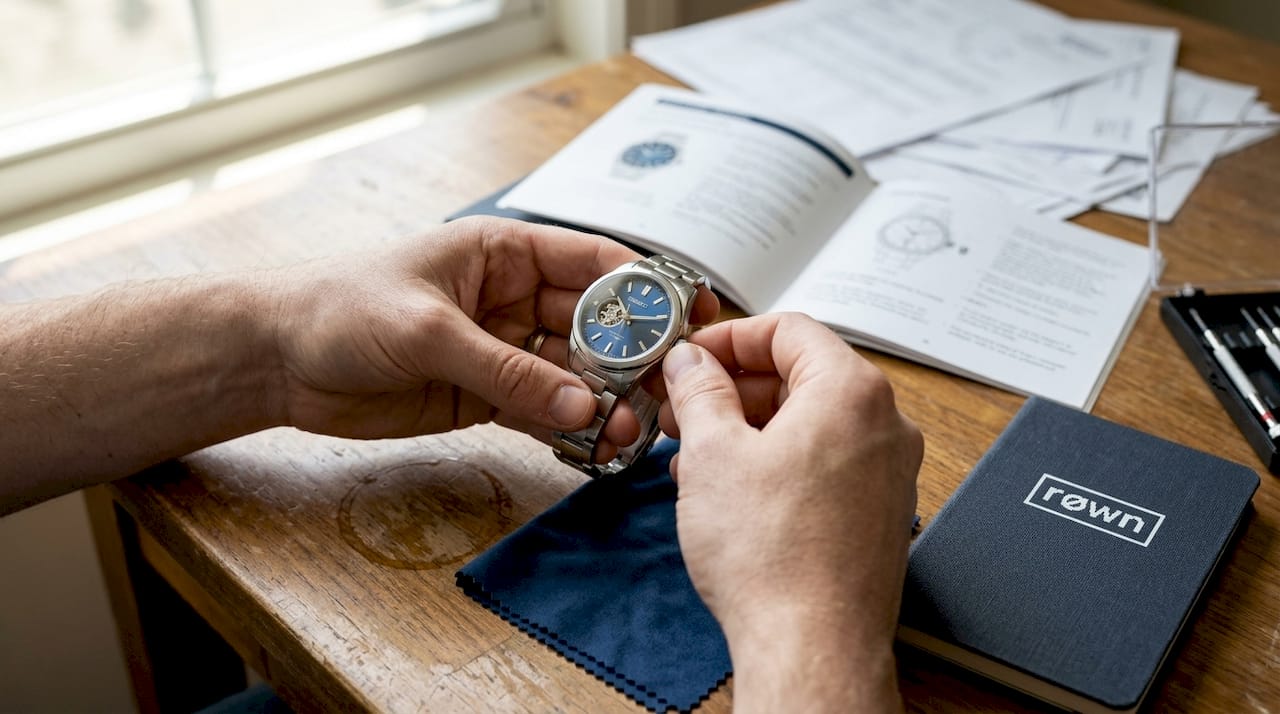
Step 4: Set the date first, but only outside the danger zone. Winding past midnight when adjusting the date can damage the date mechanism. Always set the date when the watch shows a time between 3am and 9pm. Move the hands forward past midnight to trigger the date change, then back to a safe time window before switching to date-setting mode.
Step 5: Set the time. Pull to the time-setting position. Move the hands forward only. It’s recommended to move hands forward, never backward, to protect high-end automatic movements. Align to your reference time source.
Pro Tip: Set the minute hand to 5 minutes ahead of your target time, then let it catch up. This gives you a precise sync without scrambling at the last second.
Step 6: Wind the watch manually. If the watch has been sitting unworn, give it 20 to 40 crown turns in position 1 until you feel light resistance. Don’t force it beyond that point.
Step 7: Push and lock the crown. Push the crown back in firmly and screw it down if applicable. A loose crown left out is one of the easiest ways to let moisture or dust inside. You can find more movement-specific guidance in the NH35 setup guide.
Troubleshooting and avoiding common mistakes
Even the most prepared enthusiasts can make mistakes; here’s how to avoid or fix them.
Common errors to watch for:
- Setting the date at night: Setting the date during the danger zone (typically 9pm to 3am) risks stripping gears. Always move the hands past 3am before switching to date-setting mode.
- Using the wrong crown position: Using the wrong crown position can prevent correct time or date setting and stress internal components. Confirm your position before turning.
- Overwinding: Automatic watches have a built-in slip clutch that prevents overwinding in most modern movements. Still, stop winding once you feel firm resistance.
- Moving hands backward: This can desync the date mechanism from the timekeeping display.
- Setting while on your wrist: Lateral pressure on the crown stem during setting strains the winding mechanism over time.
What to do if the watch stops: Simply wind it manually and go through the full setup process again. A stopped watch is not necessarily broken. It usually just needs power.
When to consult a professional:
- The crown feels unusually stiff or spins without engaging
- The watch loses more than 30 seconds per day consistently
- The date doesn’t change at midnight
- You hear grinding or feel irregular resistance while winding
For setting custom watches with added complications, the stakes are slightly higher. More features mean more interaction points, so precision in every step matters.
Warning: Never force the crown in any direction. If it resists, stop. Forcing can break the stem or damage the setting mechanism, requiring full movement disassembly to repair.
Verifying accuracy and maintaining your automatic watch
Once set, keeping your watch in top shape is straightforward with these maintenance and verification tips.
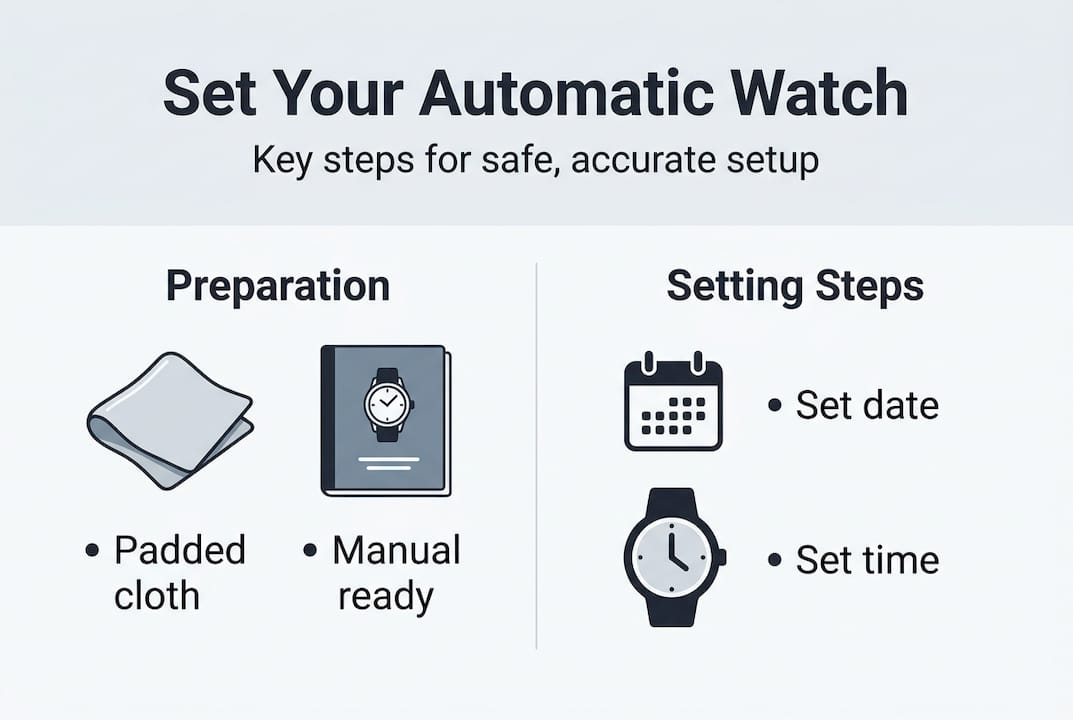
After setting, wear the watch for 48 hours and compare it to a reliable reference. A healthy automatic movement typically runs within plus or minus 10 seconds per day. That’s a small, acceptable variance. Anything beyond 30 seconds of daily gain or loss signals a potential issue.
Performance comparison table:
| Sign | Healthy watch | Possible issue |
|---|---|---|
| Daily accuracy | Within ±10 sec/day | More than ±30 sec/day |
| Date change | At or near midnight | Off by hours or not changing |
| Crown feel | Smooth engagement | Stiff, slipping, or loose |
| Winding feel | Resistance builds gradually | No resistance or hard stop |
| Hands movement | Smooth sweep | Stuttering or jumping |
Regularly wearing and servicing your automatic watch ensures consistent timekeeping and longevity. Wearing it daily is actually one of the best things you can do for an automatic.
Ongoing care tips:
- Store unworn watches in a watch box or winder to maintain power reserve.
- Keep the watch away from strong magnetic fields, extreme temperatures, and high humidity.
- Have it professionally serviced every 3 to 5 years, or sooner if you notice issues.
- Clean the case and bracelet with a damp cloth monthly. Avoid submerging unless the watch is rated for water resistance.
- Check your long-term automatic watch care guide for model-specific storage and maintenance tips.
For custom builds, pay attention to each component’s specifications. A custom bezel or bracelet may have its own care requirements separate from the movement.
Why most luxury watch owners overcomplicate the process
Here’s an honest take: most watch owners spend far too much mental energy worrying about perfect accuracy. They obsess over every second of daily variance, adjust the crown repeatedly, and end up stressing a movement that was designed to handle normal wear with ease.
Automatic watches are built to be worn, adjusted, and lived in. A few seconds of daily drift is not a flaw. It’s physics. No mechanical movement is perfect, and that’s part of what makes them interesting. Your watch doesn’t need to match an atomic clock to serve its purpose beautifully.
What actually damages watches is not minor inaccuracy. It’s repeated unnecessary crown adjustments, forced setting in the danger zone, or leaving the crown unscrewed. The mechanical movement inside your watch is resilient when you follow the basics and leave it alone otherwise.
Enjoyment comes from wearing your watch, building a distinct style in luxury watches, and personalizing the pieces that matter to you. Trust your setup process, verify accuracy once after setting, and then get back to wearing it.
Discover luxury customization and upgrade options
You’ve mastered the setup. Now it’s time to make the watch truly yours.

At Røwn Jewelry, we build customizable automatic watches designed for enthusiasts who care about every detail. Browse our curated selection of men’s luxury watches and women’s luxury watches to find your next timepiece, or go further with a fully bespoke build. Our custom diver watch is a great starting point for those who want to combine function, style, and complete personalization. Every component is chosen by you, built to last, and shipped free.
Frequently asked questions
Can I damage my automatic watch by setting it incorrectly?
Yes, setting the date at the wrong time or using improper force on the crown can damage the movement or date mechanism. Setting the date during the danger zone (typically 9pm to 3am) risks stripping gears.
How often should I wind my automatic watch?
You’ll need to wind your automatic watch if it hasn’t been worn daily, typically 20 to 40 turns or until you feel light resistance. Automatic watches use kinetic energy from wrist movement to self-wind, so regular wear reduces the need for manual winding.
What should I do if my automatic watch stops?
Simply wind it manually and reset the time and date according to the setup instructions, avoiding the danger setting times. Winding past midnight when adjusting the date can damage the date mechanism, so start with the hands in a safe position.
When should I bring my automatic watch to a professional for servicing?
If you notice time inaccuracy beyond 30 seconds per day, resistance during winding, or irregular behavior, seek a qualified watchmaker. Regularly wearing and servicing your automatic watch ensures consistent timekeeping and longevity over the long term.