

TL;DR:
- True customization involves selecting every component, from case shape to movement, for a personalized watch.
- The case and dial have the greatest visual impact, shaping the watch’s overall style.
- Choosing the movement and finishing details reflects your craftsmanship and personal taste beyond branding.
Most people think customizing a watch means swapping the strap or picking a different color dial. That’s just the surface. A truly personalized luxury automatic watch involves decisions across every component, from the case shape and movement type to the crystal material and caseback finish. Each choice affects how the watch looks, feels, and performs on your wrist. When you understand what each part does and how it contributes to the overall design, you stop settling for close enough and start building something that’s genuinely yours. This guide walks you through every major component so you can make confident, informed decisions.
Table of Contents
- Core components of a custom watch
- How to choose custom watch movements
- Dials and hands: Expressing your style
- Straps, bracelets, and fastening finishes
- Rethinking luxury: Why true customization goes beyond branding
- Start your custom watch journey with røwn
- Frequently asked questions
Key Takeaways
| Point | Details |
|---|---|
| Every part matters | Understanding and selecting each component lets you design a truly personal watch. |
| Movement defines value | Choosing the right movement shapes how your watch works, feels, and signals prestige. |
| Style is in the details | Dial, hands, and straps make a bigger difference than branding alone for standing out. |
| Fit and comfort | Custom straps and clasps ensure your luxury watch feels as good as it looks. |
Core components of a custom watch
Custom watchmaking gives you control over far more than most buyers realize. Every part of a watch, inside and out, can be selected to reflect your taste, lifestyle, and standards. Here’s a breakdown of the key components you can personalize.
Case: The case is the physical housing of your watch. It defines the overall silhouette and sets the visual tone before anyone looks at the dial. You can choose from round, cushion, tonneau, or rectangular shapes. Materials include stainless steel, titanium, DLC-coated steel, and even gold. Size matters too. A 40mm case reads as classic and versatile, while a 44mm case projects a bolder, sportier presence.
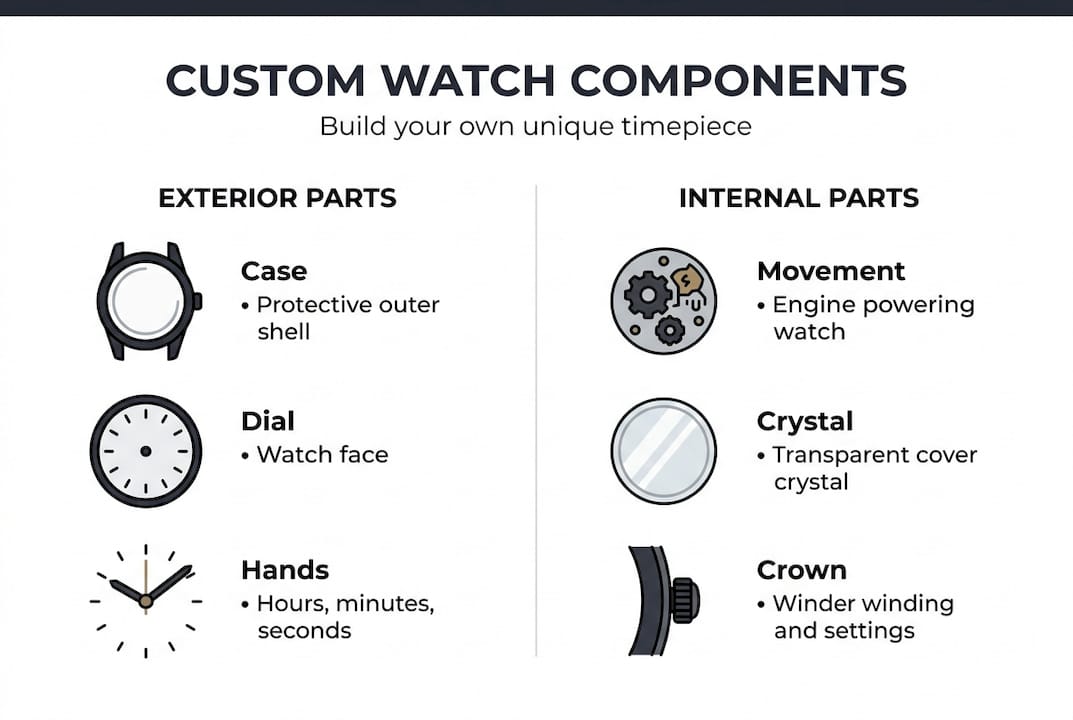
Dial: The dial is the face of your watch and the most expressive component. You can select colors, finishes (matte, sunburst, guilloche), numeral styles (Arabic, Roman, or none), and index types (applied markers, printed, or luminous). Some builders even allow logo or monogram placement. According to the guide to custom watch personalization, shoppers can personalize watches by choosing custom retail components across every visual layer.
Hands: Hands affect both legibility and character. Sword, dauphine, baton, and cathedral are common shapes. Finish options include polished, brushed, or PVD-coated. Lume application (a glow-in-the-dark coating) adds function for low-light readability.
Movement: This is the engine inside. Automatic movements wind themselves through wrist motion. Quartz movements run on a battery and are more accurate. Skeleton movements expose the internal mechanics through an open dial, adding a visual layer of sophistication. More on this in the next section.
Crystal: Mineral crystal is scratch-resistant and budget-friendly. Sapphire crystal is harder, more scratch-resistant, and the standard for luxury pieces. Domed sapphire adds a vintage aesthetic.
Crown and caseback: The crown is the winding and setting knob on the side of the case. Screw-down crowns add water resistance. Exhibition casebacks are transparent, letting you view the movement from the rear, which is a popular choice for automatic watches.
| Component | Primary design effect |
|---|---|
| Case | Shape, size, and material define the overall silhouette |
| Dial | Color, finish, and numerals set the visual personality |
| Hands | Style and lume affect legibility and elegance |
| Movement | Visible mechanics or hidden engine shapes prestige |
| Crystal | Dome or flat profile changes the vintage vs. modern feel |
| Crown/caseback | Exhibition glass or screw-down adds function and style |
Pro Tip: Start your design decisions with the case and dial. These two components have the greatest visual impact and will guide your choices for everything else, including hands, crystal, and strap.
How to choose custom watch movements
Understanding the core physical parts matters, but the movement inside is the beating heart. It sets the tone for how the watch feels and wears over time. Choosing the right movement is one of the most important decisions in personalizing luxury automatic watches.
A movement is the internal mechanism that powers your watch. It controls timekeeping, drives the hands, and in some cases powers complications like date displays or GMT functions. In the custom watch world, your movement choice signals both your priorities and your standards.
Automatic vs. quartz: Automatic movements are mechanical. They wind themselves using a rotor that spins with wrist movement. They require no battery, but they do need periodic servicing every 3 to 5 years. Quartz movements use a battery-powered oscillator and are accurate to within seconds per month. Automatic movements carry more prestige in the luxury space because of their craftsmanship and engineering.
Skeleton movements: A skeleton movement has material removed from the movement plate to expose the gears, springs, and escapement. Paired with an exhibition caseback or open-heart dial, it turns the mechanics into a visual feature. It’s a bold choice that works best with minimalist dials.
Decorated movements: Some movements feature hand-applied finishing techniques like Geneva stripes (also called Côtes de Genève) or perlage (circular graining). These are visible through an exhibition caseback and add a layer of artisanal quality.
| Movement type | Accuracy | Power reserve | Maintenance |
|---|---|---|---|
| Quartz | ±15 sec/month | Battery dependent | Battery every 1-2 years |
| Automatic | ±10-25 sec/day | 38-72 hours typical | Service every 3-5 years |
| Skeleton automatic | ±10-25 sec/day | 38-72 hours typical | Service every 3-5 years |
The movement you choose defines more than accuracy. It defines what kind of watchmaker you are. A well-chosen movement, visible through an exhibition caseback, tells a story that no logo ever could.
You can explore specific watch movement types to find options available for purchase as individual components.
Consider upgrading your movement if:
- You want the watch to be a long-term heirloom piece
- You’re choosing an exhibition caseback
- You want to avoid battery replacements
- You value the mechanical craft behind horology
Dials and hands: Expressing your style
With the internal engine considered, it’s time to focus on the most visible elements. The dial and hands are where you can express the most individuality, and where small decisions create big visual differences.

Dial options: The finish of your dial changes everything. A sunburst finish catches light differently throughout the day, giving the watch a dynamic, living quality. A matte dial reads as clean and modern. Guilloche patterns, which are engraved geometric textures, add depth and a traditional luxury feel. Color choices range from classic black and white to bold blue, green, or even salmon.
Sub-dials, which are smaller dials within the main dial used for complications like chronographs or GMT displays, add function and visual complexity. If you want a cleaner look, stick to a single-register design.
Hand options: Hand shape changes the character of the watch immediately. Sword hands are sporty and bold. Dauphine hands are elegant and tapered. Baton hands are minimal and modern. You can also choose lume application for nighttime visibility, a practical feature that doesn’t compromise aesthetics during the day. Details on customizing watch hands show how retail buyers select these elements for a unique luxury look.
Top ways to customize dials and hands for luxury appeal:
- Choose applied (three-dimensional) indices over printed ones for a premium look
- Match hand finish to case material for a cohesive design
- Use lume on both hands and indices for a unified nighttime aesthetic
- Select unique custom dials with texture or pattern for visual depth
- Avoid overcrowding the dial with too many complications if legibility matters to you
Pro Tip: Strong contrast between the dial and hands, like white hands on a dark dial, maximizes legibility and gives your watch a distinctive, professional look that reads well in any lighting condition.
Straps, bracelets, and fastening finishes
Once you’ve crafted the right case and dial, finishing your timepiece with personalized straps and clasps is the final touch. The band you choose affects comfort, durability, and the overall vibe of the watch.
Leather straps are classic and dress-ready. Full-grain leather develops a patina over time, making the strap uniquely yours. Alligator and ostrich leather add texture and exclusivity. However, leather doesn’t handle moisture well, so it’s not ideal for active wear.
Steel bracelets are the most durable option and pair naturally with steel cases. Oyster and jubilee are the two most common bracelet styles. They’re heavier than other options but feel substantial and premium on the wrist.
Rubber and silicone straps are built for performance. They handle sweat, water, and heat without degrading. They’re the go-to for dive watches and sports-oriented builds.
NATO straps are nylon bands that thread through the spring bars and sit under the case. They’re lightweight, colorful, and easy to swap. They add a casual, military-inspired look.
The complete guide to watch customization steps outlines how strap selection fits into the full build process.
How to match a strap to your style and use:
- Identify your primary use case (dress, sport, casual, or everyday)
- Match the strap material to the case finish (brushed steel pairs well with rubber or steel)
- Choose clasp type: tang buckle for simplicity, deployant clasp for security and ease
- Consider width compatibility with your case lug width
- Review custom strap options for materials and styles that suit your build
Watch out for these strap concerns:
- Nickel in metal clasps can cause skin reactions in sensitive individuals
- Leather degrades faster in humid or wet environments
- Rubber straps may crack over time with UV exposure
- NATO straps add thickness under the case, which can affect fit on smaller wrists
Rethinking luxury: Why true customization goes beyond branding
Most men who buy luxury watches are buying a logo. That’s honest. The name on the dial signals status, and there’s nothing wrong with that. But here’s the uncomfortable truth: a logo gives you the same watch as thousands of other buyers. The satisfaction fades faster than you’d expect.
Real luxury comes from decisions only you made. When you choose the movement, the dial finish, the hand shape, and the clasp, you’re building something with your own judgment behind it. That’s a different kind of ownership. It’s not about showing off a brand. It’s about wearing something that reflects your actual taste.
The expert steps for custom watches show that the process of building a watch, component by component, creates a connection to the piece that no off-the-shelf purchase can replicate. You know what’s inside. You chose it. That’s what makes it genuinely yours.
Start your custom watch journey with røwn
Feeling inspired to create a totally unique timepiece? Røwn makes it straightforward to go from concept to finished watch, with a curated selection of components and a builder that puts the decisions in your hands.
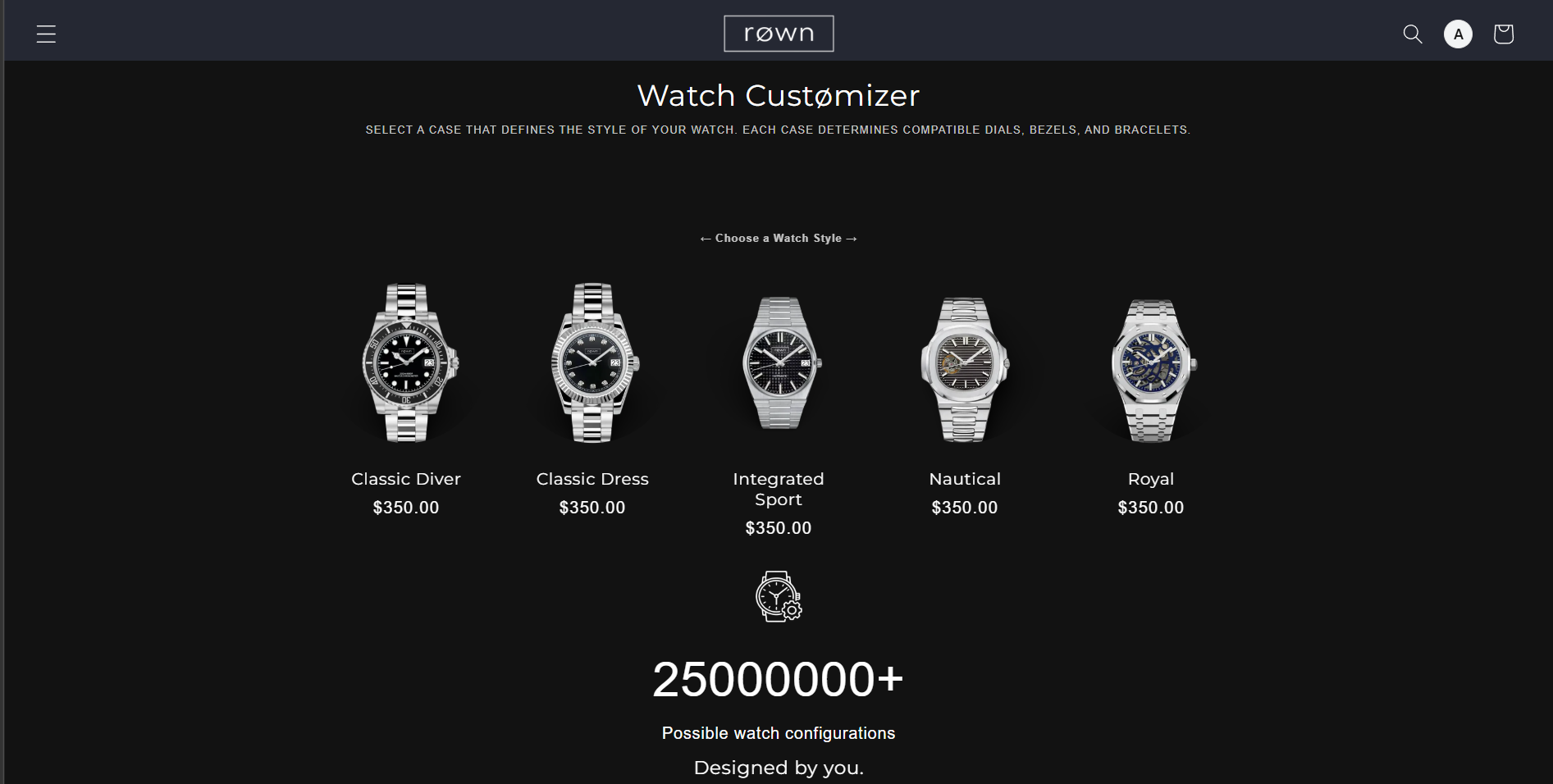
You can explore men’s watches to browse the full range of cases, dials, and movements available. If you’re ready to go hands-on, the build your own diver option walks you through every component selection step by step. And if you want to complete the look, you can shop bracelets to find the right band for your build. Free shipping and a high customer rating make røwn a reliable starting point for your first or next custom watch.
Frequently asked questions
Which watch components have the most impact on style?
The case, dial, and hands have the biggest influence on your watch’s overall appearance. Customizing dials and hands for a unique look is one of the most effective ways to personalize a luxury timepiece.
What movement is best for a luxury custom watch?
Automatic (mechanical) movements are preferred for luxury timepieces because of their craftsmanship and legacy. You can review watch movement types to compare options and find the right fit for your build.
Can I swap straps on custom watches easily?
Yes, many custom luxury watches are designed with easy strap-changing systems. Custom strap options vary widely in material and style, and most use standard spring bar attachments for quick swaps.
Is it possible to mix and match components across brands?
Some components, especially straps and buckles, can be mixed across brands. Cases and movements, however, usually require manufacturer compatibility and specific tolerances to fit correctly.
Does customizing a watch affect its resale value?
Fully customized watches often carry higher personal value but may resell for less than mainstream branded models. The trade-off is a piece that’s built for you, not the resale market.