

TL;DR:
- Handmade watches are unique, handcrafted by artisans, featuring subtle individual variations.
- They carry deep personal and heirloom value, customizable to reflect owner’s story and preferences.
- Supporting responsible craftsmanship and small-scale production, they often outperform mass-market watches in market demand and investment potential.
Most people assume that precision machines produce better watches than human hands ever could. That assumption deserves a closer look. Handmade watches deliver emotional value, heirloom potential, sustainable sourcing, and investment upside that factory lines simply cannot replicate. Demand for independent handmade watches has surged in recent years, and the reasons go far beyond nostalgia or aesthetics. In this article, you will learn exactly what sets handmade watches apart, why they carry deep personal meaning, how they support responsible craftsmanship, and why collectors are treating them as serious investments.
Table of Contents
- What makes handmade watches unique?
- Emotional value, heirloom potential, and personalization
- Sustainability and responsible craftsmanship
- Investment value: Market trends for handmade watches
- Our take: What mass-market brands can’t replicate
- Discover your own handcrafted watch or custom accessory
- Frequently asked questions
Key Takeaways
| Point | Details |
|---|---|
| Handmade means unique | Every handmade watch carries distinct details, character, and craftsmanship you won’t find in mass-produced products. |
| Heirloom and emotional value | Handmade watches are meaningful gifts and heirlooms that connect generations through personal stories. |
| Sustainability focus | Choosing handmade supports local artisans and encourages sustainable, low-waste practices. |
| Rising investment value | Independent handmade watches are increasingly sought after and have even outperformed some luxury giants at auction. |
What makes handmade watches unique?
Let’s start by clarifying what actually sets handmade watches apart from machine-made alternatives.
When most people hear “handmade watch,” they picture someone assembling parts by hand. But real handmade watchmaking goes much deeper than that. It involves individual artisans who shape, finish, and test every component with a level of care that automated production lines cannot match. The watchmaker’s expertise shows in the finishing, the weight, and the way the watch feels on your wrist.
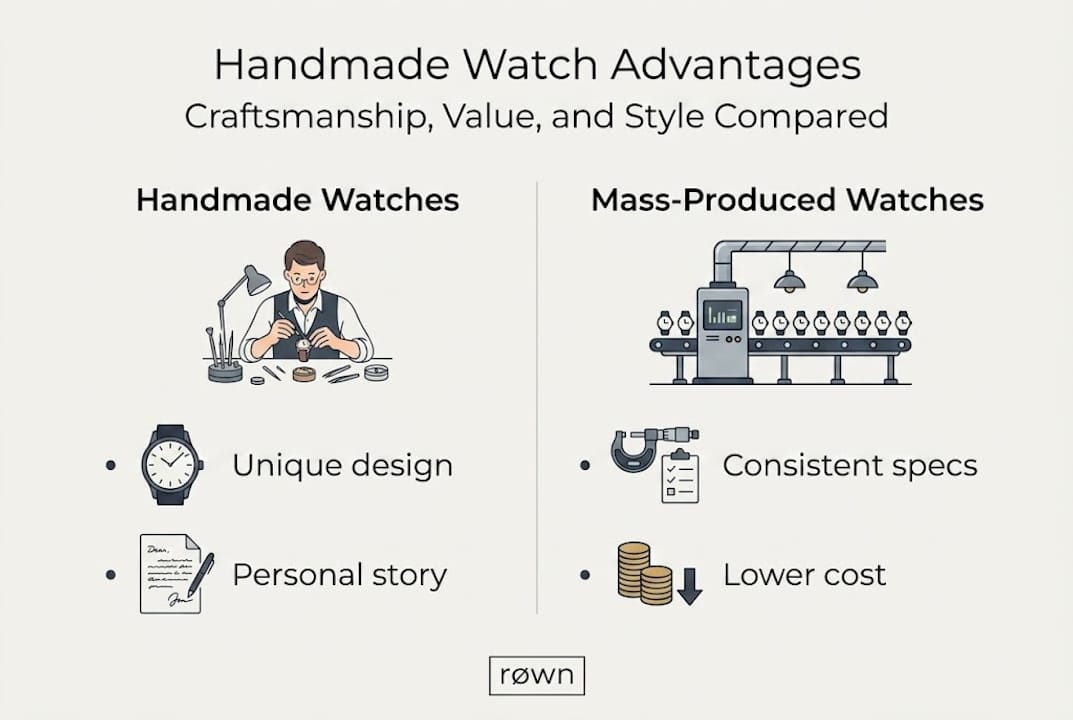
Machine-made watches are engineered for consistency. Every unit should look exactly like the last. Handmade watches, by contrast, carry subtle individuality. The brushed surfaces, hand-applied indices, and hand-polished bevels each carry microscopic traces of the craftsman who made them. That is not a flaw. That is identity.
Here are the key characteristics that define genuinely handmade watches:
- Individual component finishing: Artisans hand-polish, grind, and angle each part separately.
- Unique dial treatments: Hand-applied enamel, guilloché patterns, and hand-painted details cannot be perfectly replicated at scale.
- Custom case work: Bevels, lugs, and crowns are individually shaped and finished.
- Rigorous quality testing: Up to 400 hours of testing per model ensures every piece performs as intended.
- Limited production: Most handmade makers produce far fewer watches per year than mass-market brands, which drives exclusivity.
Collectors prize handmade watches because no two are identical. Even from the same limited run, tiny variations in finishing make each piece one of a kind. That uniqueness is something no factory can manufacture on demand.
“A handmade watch is not a product — it is a record of someone’s skill, time, and intention.”
When you explore custom watch craftsmanship, you will quickly realize how much thought goes into each design decision. From the dial layout to the choice of bracelet, every element tells a part of the story. Understanding unique watch components also helps you appreciate what separates a hand-finished piece from a catalog product.
Pro Tip: When evaluating whether a watch is truly handmade, ask the seller specifically about the finishing process. Marketing terms like “assembled by hand” or “hand-inspected” are not the same as genuine hand finishing and hand craftsmanship. Ask for details about which components are shaped, finished, or decorated by artisans.
Emotional value, heirloom potential, and personalization
While artistry sets handmade watches apart, their true significance is often personal.
A watch tells time. But a handmade watch tells your story. When you choose the dial color, the case material, the engravings, and the bracelet style, you are building something that reflects who you are. It is not just an accessory. It is a statement about what you value.
Handmade watches carry emotional value that factory-made pieces struggle to match. You can learn how to personalize your luxury watch so that every detail reflects your identity, from the movement type to the finishing style. That level of input creates a connection to the object that lasts far longer than any trend.
Handmade watches also make extraordinary gifts. Compare what you are actually giving when you choose a handmade piece versus a factory option:
Factory watch as a gift:
- Chosen from a catalog with fixed options
- Identical to thousands of other units sold that year
- No personal customization beyond color selection
- Value tied entirely to brand recognition
Handmade watch as a gift:
- Designed with specific details for the recipient
- Unique finish and components that reflect personal taste
- Can include engravings, birthstones, or personal inscriptions
- Carries the story of its creation and the intent behind it
The heirloom potential of a well-crafted handmade watch is also significant. When maintained properly, a mechanical handmade watch can last multiple generations. Passing one down becomes a family tradition, not just a transfer of property. Following custom watch personalization steps allows you to build a piece that is worth handing down.

Pro Tip: When commissioning a handmade or custom watch as a gift or heirloom piece, plan at least 4 to 6 weeks ahead. Discuss the recipient’s lifestyle, their preferred wrist presence, and whether they favor formal or casual styles. The more context you give, the more meaningful the final result.
Sustainability and responsible craftsmanship
Beyond personal meaning, there is also a growing focus on sustainability in the luxury market.
The watch industry is not exempt from environmental scrutiny. Large-scale manufacturing generates significant waste, relies on global supply chains with high carbon footprints, and often uses materials with unclear sourcing. Handmade watchmakers operate differently. Handmade watches use local materials and produce far less waste per unit compared to mass production.
Here is a side-by-side comparison of the environmental footprint:
| Factor | Handmade watches | Mass-produced watches |
|---|---|---|
| Material sourcing | Often local or traceable | Global, often untracked |
| Production waste | Minimal, component-specific | High volume industrial waste |
| Energy use | Small workshops, low output | Large factories, high consumption |
| Supply chain length | Short and transparent | Long and complex |
| Repairability | High, components sourced individually | Often replaced, not repaired |
Choosing a handmade watch means supporting a shorter, more transparent supply chain. It also means your purchase supports an individual artisan or a small studio, not a shareholder report.
The sustainability benefits include:
- Reduced overproduction: Handmade makers produce to order or in small batches, so fewer unwanted units end up in landfills.
- Local economy support: Purchasing from independent makers keeps money within craft communities.
- Lower shipping footprint: Shorter supply chains mean fewer international freight movements.
- Longer lifespan design: Handmade watches are built to be serviced and repaired, not discarded.
Exploring eco-friendly luxury watches can help you identify brands and makers who prioritize responsible sourcing. If you want to go further, building a sustainable watch from scratch gives you full control over every material and component choice.
Investment value: Market trends for handmade watches
For some buyers, the appeal extends beyond personal satisfaction to financial upside.
The collector market for handmade and independent watches has shifted dramatically over the past decade. Independent handmade watch brands have seen rising demand, multi-year waitlists, and measurable growth in auction value. What was once a niche community of enthusiasts has become a serious investment category.
Waitlists are one of the clearest signals of demand. When buyers are willing to wait two or three years for a specific independent watch, the secondary market value rises accordingly. Scarcity and craftsmanship together create the conditions for strong resale performance.
Here is how independent makers compare to established luxury brands at auction:
| Category | Auction performance | Waitlist status | Collector demand |
|---|---|---|---|
| Independent handmade | Rising, often beating estimates | Multi-year for key models | Growing rapidly |
| Major luxury brands | Stable but slower growth | Common for flagship lines | Established but saturated |
| Mass-market brands | Flat or declining | Rarely applicable | Limited |
Independent makers are now outperforming some luxury giants at auction, which signals a real shift in how the market values craftsmanship over brand name alone.
If you are considering handmade watches as an investment, here is how to evaluate a piece:
- Research the maker’s history: Established independent watchmakers with a track record carry more investment credibility.
- Check limited production numbers: The fewer units made, the more likely scarcity will support value over time.
- Assess movement quality: In-house or hand-finished movements typically attract more collector interest than off-the-shelf calibers.
- Review auction history: Look at how similar pieces from the same maker have performed at auction in recent years.
- Consider condition and provenance: Original packaging, documentation, and purchase history all support long-term value.
For further context on the market, reviewing branded watch investment insights can help you understand how independent pieces stack up against recognized names.
Our take: What mass-market brands can’t replicate
Stepping back, let’s look at what the numbers and stories really mean for you as a collector or a newcomer to watches.
Most comparisons between handmade and mass-market watches focus on specs: movement accuracy, water resistance, or brand heritage. But that framing misses the point entirely. The real difference is in what a watch means to its owner, and that is something no factory can standardize.
We have seen buyers choose technically superior mass-market watches and feel nothing when they wear them. We have seen others choose a modest handmade piece and treat it like a family member. That gap is not about quality metrics. It is about connection.
Mass-market brands are very good at what they do. They deliver consistency, brand recognition, and reliable resale value within established tiers. What they cannot deliver is the sense that the watch was made for you, by someone who cared about the outcome.
If you are just starting to explore this space, our expert watch-building tips will help you move from curiosity to confident decisions.
Pro Tip: Start your handmade watch journey with one customized piece rather than collecting broadly. Learning what you love through a single thoughtfully built watch will sharpen your taste and inform every future purchase.
Discover your own handcrafted watch or custom accessory
Ready to start your journey toward a watch with real story and significance? Explore these high-quality options.
At Røwn Jewelry, we make it straightforward to find or build a handmade watch that fits your style and intent. Whether you prefer bold, sporty designs or refined, minimal aesthetics, there are options built for both.
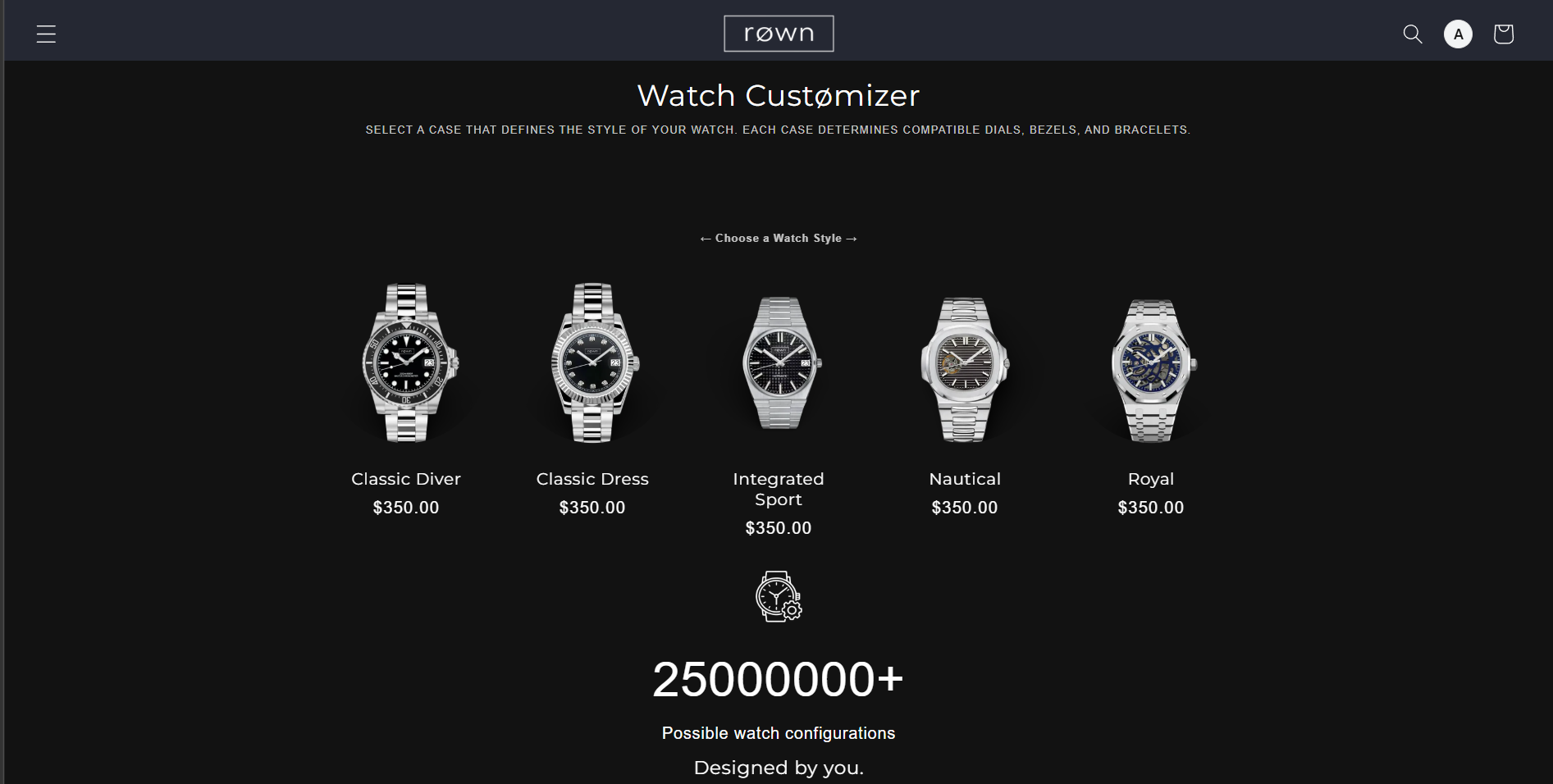
Browse men’s handmade watches and women’s handmade watches to see the full range of customizable timepieces available. If you want something with serious depth and character, the custom diver watches are a standout option. Each piece can be tailored to your exact preferences, from dial to bracelet. Start building something worth wearing for a lifetime.
Frequently asked questions
Are handmade watches more reliable than machine-made ones?
Handmade watches may require more regular servicing, but they offer unmatched craftsmanship and individuality. Machine-made watches prioritize consistent reliability, while handmade pieces command premiums for their artistry and uniqueness.
Why do handmade watches cost more?
The price reflects the time, skill, and materials involved. Up to 400 hours of testing and finishing per model alone justifies a significantly higher price point compared to factory-made alternatives.
Is a handmade watch a good investment?
For select independent makers, yes. Independent makers are outperforming some major luxury brands at auction, and collector demand for handmade pieces continues to grow year over year.
Can you customize every aspect of a handmade watch?
Most makers offer extensive options covering dials, hands, cases, materials, and personal engravings, so your watch can reflect your exact taste and story.
How long does it take to make a handmade watch?
Production and testing alone can span weeks to several months. With up to 400 hours of testing per model, quality takes time, and that time is part of what makes the finished piece worth wearing.