

TL;DR:
- Watch movement is the internal mechanism powering the watch, with mechanical and quartz being the main types.
- Mechanical watches emphasize craftsmanship and tradition, while quartz offers higher accuracy and lower maintenance.
- Movement choice impacts a watch’s value, customization options, longevity, and personal connection.
Two watches can look nearly identical on the wrist. Same case size, same dial color, same bracelet. Yet one sells for $200 and the other for $2,000. The difference almost always lives inside. The movement, the engine that powers every tick, is what separates a disposable timepiece from a watch worth passing down. If you’ve ever wondered why collectors obsess over calibers or why certain builds feel more alive than others, this guide will clear that up. By the end, you’ll know exactly what movement means, how to compare your options, and how to use that knowledge when choosing or customizing your next timepiece.
Table of Contents
- What is a watch movement? Understanding the basics
- Mechanical vs. quartz: Precision, artistry, and purpose
- Why movement matters: Impact on value, customization, and longevity
- How movement influences accuracy: The standards that matter
- What most guides miss: The personality and legacy of movement choice
- Bring your movement knowledge to life with røwn
- Frequently asked questions
Key Takeaways
| Point | Details |
|---|---|
| Movement defines value | The movement determines not just function but craftsmanship, legacy, and long-term worth. |
| Accuracy depends on movement | Mechanical and quartz watches achieve different precision and require different maintenance. |
| Customization starts with movement | Your choice of movement unlocks or limits personalization and future servicing options. |
| Luxury is in the details | Finishing, certification, and movement type all influence resale and collector appeal. |
What is a watch movement? Understanding the basics
A watch movement is the internal mechanism that powers the watch and drives every function you see on the dial. Think of it as the engine under the hood. Everything else, the case, the dial, the hands, is just the body around it.
There are three main movement types worth knowing:
- Mechanical (manual): You wind the crown by hand to store energy in the mainspring. No battery needed.
- Mechanical (automatic): A rotor spins with your wrist movement and winds the mainspring automatically.
- Quartz: A battery sends electrical pulses through a quartz crystal to regulate time. Extremely accurate and low maintenance.
- Spring Drive: A hybrid developed by Seiko that combines a mechanical mainspring with an electronic regulator for exceptional accuracy.
Inside a mechanical movement, four core components work together:
- Mainspring stores the energy when wound.
- Gear train transfers that energy to the hands.
- Escapement releases energy in controlled increments.
- Balance wheel and hairspring regulate the rate, acting as the movement’s heartbeat.
Mechanical movements rely on mainsprings, gears, and escapements for energy storage and regulation, and they typically require servicing every 3 to 5 years to stay in top shape. Quartz movements need far less attention but offer a different kind of ownership experience.
Craftsmanship is where luxury movements separate themselves from mass-market ones. High-end calibers feature hand-finishing, beveled edges (known as anglage), and decorative patterns like Côtes de Genève stripes or perlage. These details aren’t functional. They’re a statement of care and skill. If you want to go deeper on this, mechanical watches explained covers the artistry side in detail, and our overview of watch movement types breaks down the full spectrum of options.
Pro Tip: If you’re buying a watch primarily for its movement, ask whether the caliber is visible through a display caseback. Seeing the movement in motion adds a whole new layer of appreciation.
Mechanical vs. quartz: Precision, artistry, and purpose
This is the debate that never gets old in watch communities. Both movement types keep time. But they do it differently, and they mean different things to the people who wear them.
Here’s a direct comparison:
| Feature | Mechanical | Quartz |
|---|---|---|
| Accuracy | ±5 to 25 sec/day | ±15 sec/year |
| Maintenance | Every 3 to 5 years | Battery every 1 to 3 years |
| Power source | Mainspring (wound manually or by wrist) | Battery |
| Craftsmanship | High, often hand-finished | Minimal |
| Emotional appeal | Strong among collectors | Functional, practical |
| Cost | Generally higher | Generally lower |
Quartz wins on raw accuracy. There’s no argument there. But quartz prioritizes accuracy while mechanical emphasizes artistry, and luxury enthusiasts consistently favor mechanics for craftsmanship despite the lower precision.
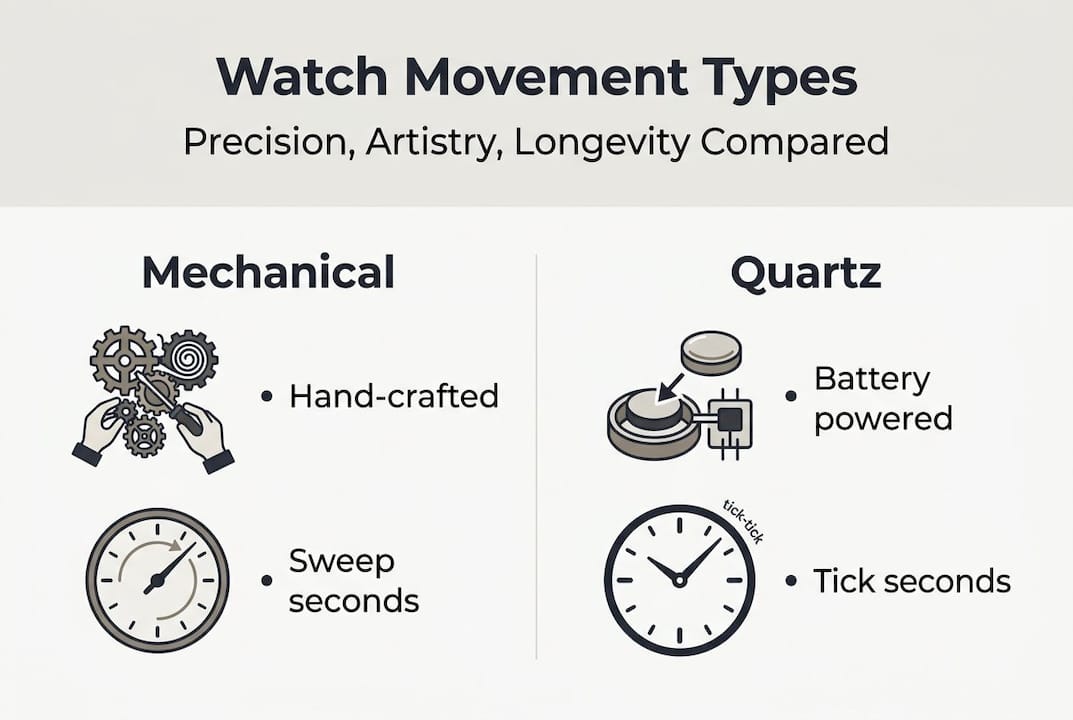
Why? Because wearing a mechanical watch is a different experience. The sweeping seconds hand, the subtle vibration of the balance wheel, the knowledge that hundreds of tiny parts are working in harmony on your wrist. It feels alive in a way quartz simply doesn’t.
Mechanical watches also carry tradition. Many calibers in production today trace their design lineage back decades. Wearing one connects you to that history.
That said, quartz has real advantages:
- Near-perfect accuracy for daily use
- No winding or rotor required
- Lower entry cost
- Ideal for tool watches or high-activity use
“The best movement is the one that fits how you live and what you value. There’s no wrong answer, only the right one for you.”
Exploring the automatic movement benefits can help you decide if the mechanical path fits your lifestyle. Your personal taste and how you interact with your watch daily should drive this choice more than any spec sheet.
Why movement matters: Impact on value, customization, and longevity
Once you understand the two main movement styles, the next question is practical. How does your movement choice affect what you can do with the watch, how long it lasts, and what it’s worth down the line?
Servicing and lifespan
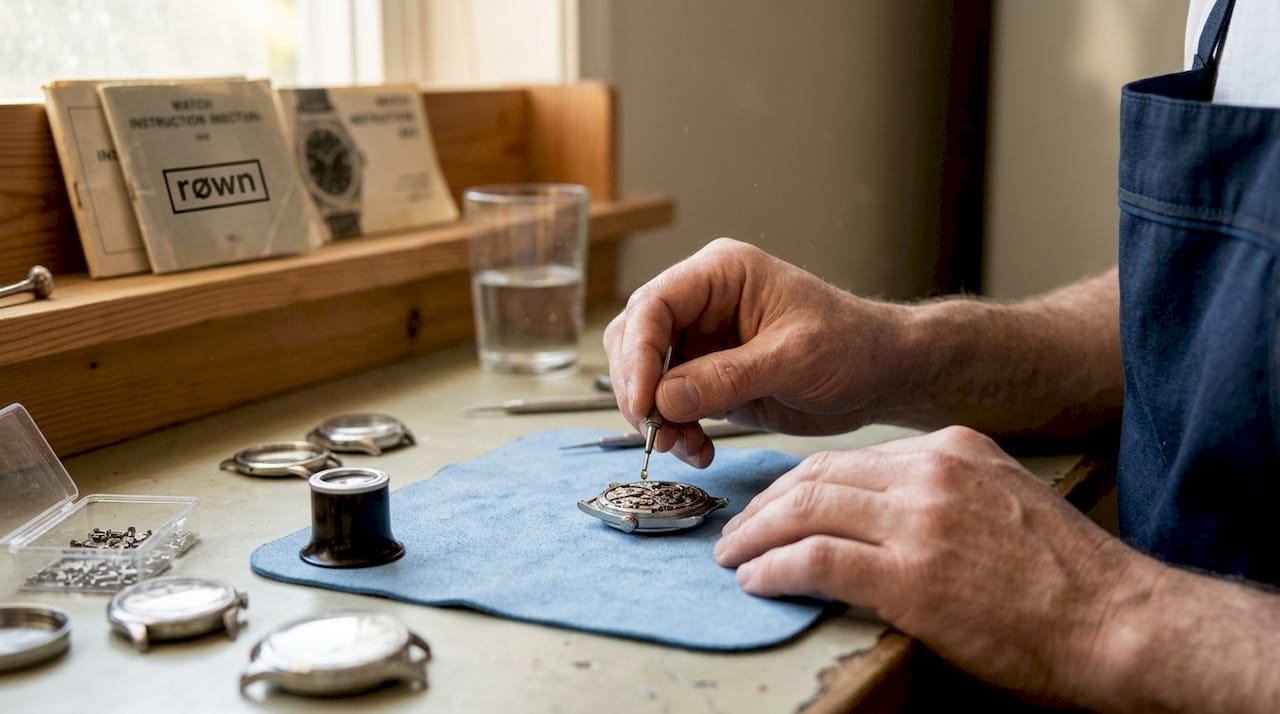
Mechanical movements need regular care. Oils dry out, parts wear, and accuracy drifts. A well-serviced mechanical watch can last generations. Quartz is more set-and-forget, but when the circuit fails, replacement is often cheaper than repair.
Customization potential
This is where movement choice gets exciting for builders. When you’re customizing your movement for a custom build, the caliber you choose shapes everything. Popular movements like the NH35 or ETA 2824 have wide aftermarket support, meaning more dial options, case compatibility, and modification possibilities.
Key factors to consider:
- Parts availability: Widely used calibers like ETA and Sellita are easier and cheaper to service anywhere in the world.
- Complication compatibility: Want a date, GMT, or chronograph? Your movement must support it.
- Rotor customization: Automatic movements allow for custom rotor engravings, a popular personalization option.
- Skeleton dials: Certain movements are designed to be displayed, making them ideal for open-heart or skeleton builds.
Resale value
Here’s where movement type really separates watches at the collector level:
| Movement type | Resale impact |
|---|---|
| In-house caliber | High, brand-exclusive and collectible |
| ETA/Sellita | Moderate, reliable but widely available |
| Modified or rare caliber | Variable, depends on demand |
| Quartz | Lower, unless vintage or limited edition |
In-house movements allow brand-specific innovations but can mean higher service costs and parts scarcity. ETA and Sellita movements are reliable workhorses with broad serviceability. Both have their place depending on your goals.
For a deeper look at how luxury watches and artistry intersect with movement choice, it’s worth seeing how top-tier finishing elevates even a familiar caliber into something special.
How movement influences accuracy: The standards that matter
Accuracy sounds simple. But in watchmaking, it’s layered with nuance. No mechanical movement keeps perfect time. The goal is to minimize deviation and maintain consistency.
Here’s what causes mechanical movements to drift:
- Temperature changes affect the elasticity of the hairspring.
- Magnetic fields can magnetize the balance wheel, disrupting its rate.
- Position (crown up, crown down, dial up) changes how gravity acts on the balance.
- Lubrication degradation increases friction over time.
- Shock can knock the balance wheel out of its regulated rate.
This is why certifications like COSC (Contrôle Officiel Suisse des Chronomètres) exist. COSC tests movements over 15 days in 5 positions and 3 temperatures, certifying an average rate of -4 to +6 seconds per day. A new 2026 Excellence Chronometer standard tightens that to -2 to +4 seconds per day on cased watches. That’s a meaningful improvement.
For context, a standard mechanical movement without certification might run at ±15 to ±25 seconds per day. A COSC-certified chronometer sits at ±6 seconds. A high-end regulated movement can reach ±2 seconds or better.
There’s also an interesting design trade-off worth knowing. Free-sprung balance wheels excel in stability for daily wear but are harder to regulate after the fact. A traditionally regulated movement is easier to adjust but may be more sensitive to disturbance. Neither is universally better. It depends on how you use the watch.
For practical daily wear, a movement running within ±10 seconds per day is perfectly acceptable. If you’re a precision-focused enthusiast, look for COSC certification or brands that publish their in-house regulation specs. Our comparison of automatic vs manual precision digs into how these differences play out in real ownership, and the servicing and care guide covers how to keep your movement performing at its best.
What most guides miss: The personality and legacy of movement choice
Most articles stop at specs. Accuracy ratings, service intervals, in-house vs. outsourced. Those things matter. But they don’t capture why someone tears up when they inherit their grandfather’s Omega or why a watchmaker spends 40 hours finishing a movement no one will ever see without a loupe.
Movement choice is personal. The way an automatic winds with your daily motion, or the ritual of hand-winding a manual every morning, shapes how you relate to the watch. It becomes a habit, a small ceremony.
There’s also legacy to consider. A well-maintained mechanical movement can outlive its owner. The legacy and meaning of luxury watches goes far beyond the object itself. Movements carry stories. They’ve been on wrists during milestones, passed through hands, and kept ticking through decades.
When you choose a movement, you’re not just choosing a timekeeping engine. You’re choosing how you’ll interact with that watch every day, and what kind of story it will carry forward.
Bring your movement knowledge to life with røwn
Now that you understand what makes a movement matter, it’s time to put that knowledge to work.
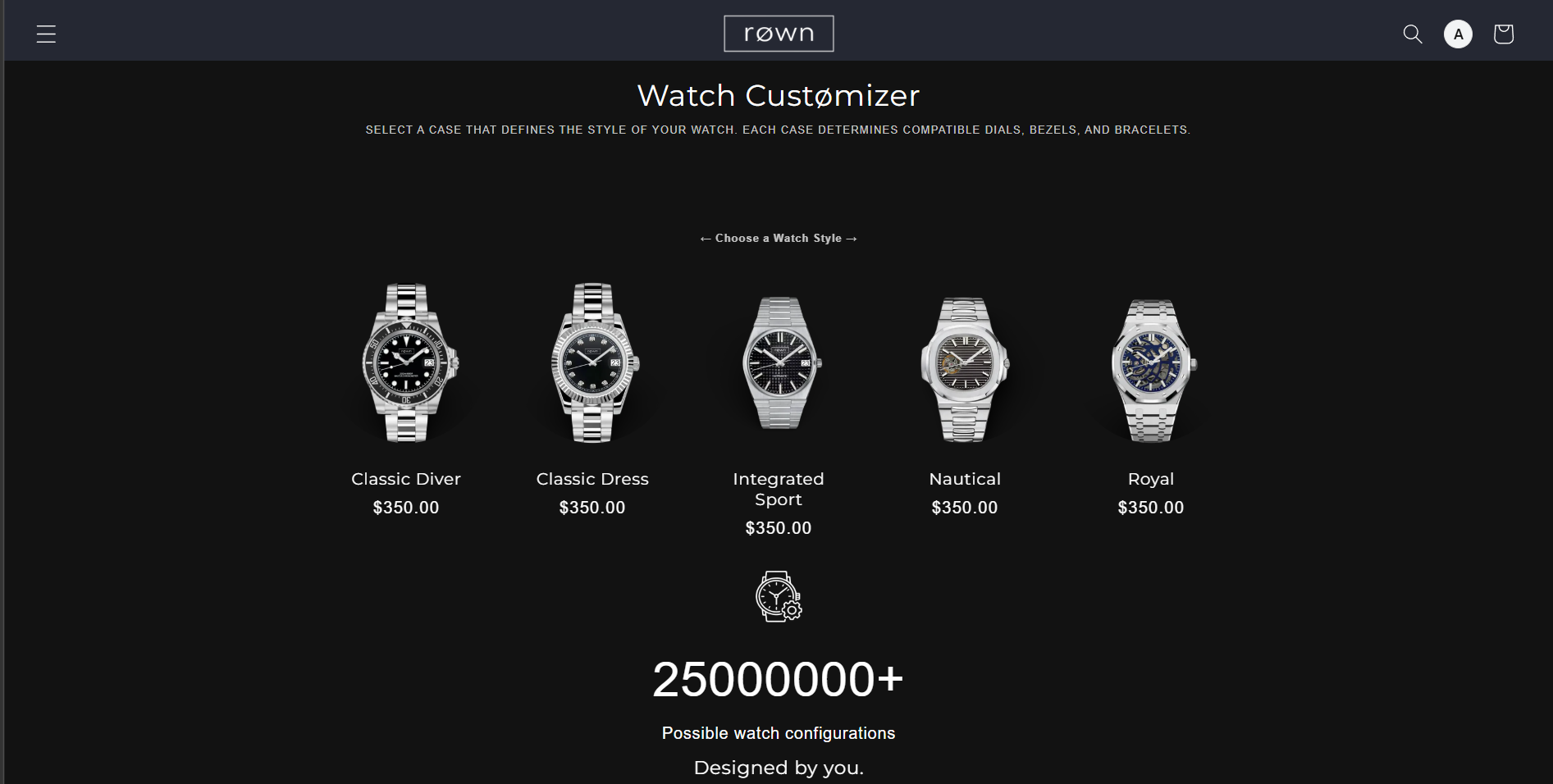
At røwn, we build around your choices. Whether you’re drawn to the precision of a regulated automatic or the simplicity of a clean quartz build, our platform gives you the tools to design something truly yours. Browse the men’s luxury watch collection for curated pieces that reflect serious craftsmanship, or go hands-on and configure your own custom diver from the case up. Every component is chosen with quality in mind. Your movement knowledge isn’t just academic now. It’s the foundation of a watch that fits exactly who you are.
Frequently asked questions
How often should I service a mechanical watch movement?
Mechanical movements require servicing every 3 to 5 years to maintain accuracy and prevent internal wear from dried lubricants and friction.
What is the most accurate watch movement?
Quartz movements are typically more accurate for daily use, but COSC-certified chronometers achieve -4 to +6 seconds per day, with the new 2026 Excellence standard tightening that to -2 to +4 seconds per day.
How does movement type affect a watch’s resale value?
In-house movements allow brand-specific innovations that drive collector demand, while widely used calibers like ETA offer serviceability but less exclusivity at resale.
Why do enthusiasts still choose mechanical over quartz?
Luxury enthusiasts favor mechanics for craftsmanship and tradition, valuing the artistry and experience of a hand-finished movement over the raw accuracy advantage of quartz.