

TL;DR:
- Mechanical watches differ significantly in winding mechanisms and daily interactions.
- Manual watches require daily winding, offering thinner profiles and a tactile experience.
- Automatic watches self-wind with wrist movement, ideal for daily wear but with thicker cases.
Many collectors assume all mechanical watches work the same way. They don’t. The difference between automatic and manual movements shapes how a watch feels on your wrist, how you interact with it daily, and what it means to own it. If you’re serious about building a watch collection or designing a custom timepiece, understanding this distinction is essential. This guide breaks down the mechanics, the ownership experience, and the pros and cons of each movement type so you can make a confident, informed choice.
Table of Contents
- How automatic and manual watches work
- Benefits and drawbacks: Practical ownership experience
- Customization, craftsmanship, and collector appeal
- Maintenance and care for automatic and manual watches
- Why movement tradition still matters in a world of options
- Discover your next unique timepiece
- Frequently asked questions
Key Takeaways
| Point | Details |
|---|---|
| Core difference | Automatic watches wind as you move, while manual watches require hand winding. |
| Ownership experience | Manual winding offers a tactile ritual, automatics favor convenience for daily wearers. |
| Customization potential | Both types allow dial, hand, and case customization for true personalization. |
| Maintenance essentials | Regular service and proper care keep either type performing at their best. |
| Collector appeal | Movement choice reflects personal values in craftsmanship and legacy. |
How automatic and manual watches work
Let’s start by clarifying the core mechanical differences.
Both movement types are purely mechanical. No batteries, no electronics. Manual and automatic watches rely on a mainspring to power the movement, but differ in how they are wound. That single difference creates two very distinct ownership experiences.
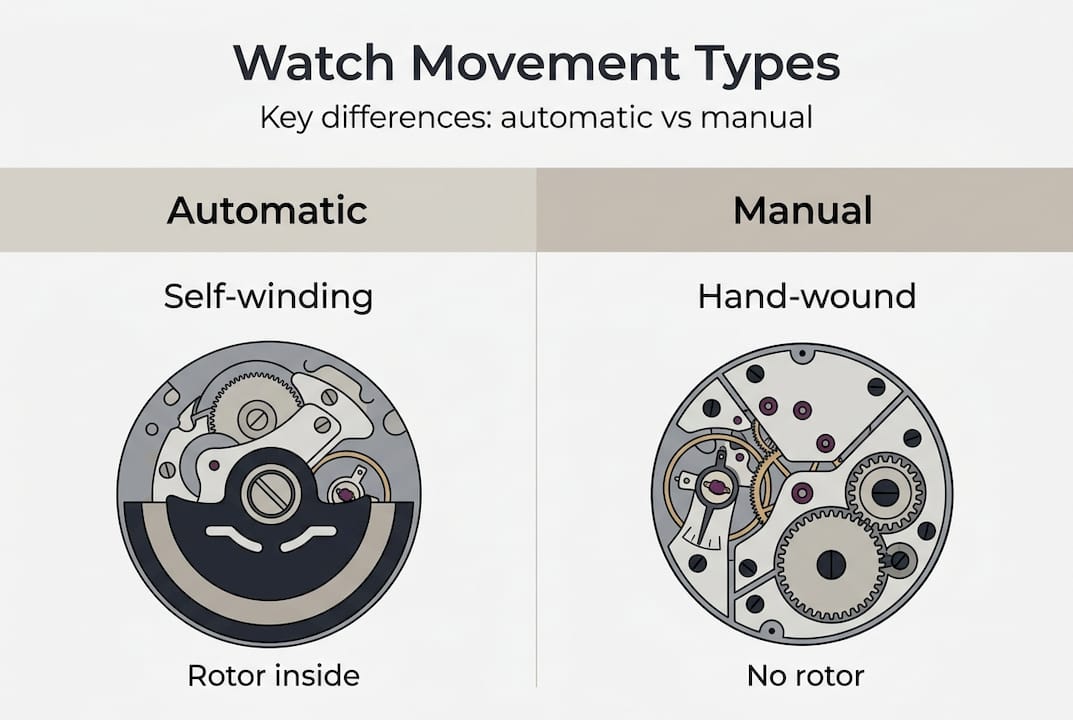
Manual watches require you to wind the crown by hand, typically once a day. You feel the resistance in the crown as the mainspring tightens. For many owners, this is a ritual they look forward to. It creates a tactile connection to the mechanism that no other watch type replicates.
Automatic watches use a semicircular rotor that spins freely as your wrist moves. That motion winds the mainspring automatically. Wear the watch regularly and it stays powered without any effort from you. If you leave it sitting for a few days, it will stop and need a manual wind or a few wrist shakes to restart.
Both types are celebrated for their craftsmanship. The mechanical watch movements inside each are assembled from dozens of tiny, precisely engineered parts. That level of artistry is a major reason enthusiasts choose mechanical over quartz.
| Feature | Manual | Automatic |
|---|---|---|
| Winding method | Hand-wound daily | Rotor winds via wrist movement |
| Power reserve | 40 to 70+ hours typical | 38 to 80+ hours typical |
| Case thickness | Generally slimmer | Slightly thicker due to rotor |
| Ideal use | Collectors, dress watches | Daily wear, sport watches |
| Interaction | High, intentional | Low, passive |
Key mechanical facts to know:
- Manual movements often have a longer, more visible gear train
- Automatics include a slipping clutch to prevent over-winding
- Both can feature hacking seconds (the second hand stops when you pull the crown)
- Skeleton designs work beautifully with either movement type
Pro Tip: Consistent daily wear keeps most modern automatics fully wound. If your lifestyle involves a lot of desk work, consider a watch winder to keep it running overnight.
Benefits and drawbacks: Practical ownership experience
With the mechanics outlined, here’s how ownership feels day-to-day.
Manual watches connect owners more directly to the mechanism. That’s a genuine advantage if you enjoy the ritual. But it’s also a commitment. Forget to wind it, and your watch stops. That can be frustrating if you’re someone who rotates between multiple timepieces.
Automatic watches remove that friction entirely. Wear them and they work. The advantages of automatics are especially clear for everyday wear. You don’t have to think about winding. The tradeoff is a slightly thicker case profile due to the rotor, which can affect how the watch fits under a shirt cuff.
| Manual | Automatic | |
|---|---|---|
| Pros | Thinner case, ritual winding, strong collector appeal | Convenient, self-winding, great for daily wear |
| Cons | Must wind daily, stops if neglected | Thicker case, rotor adds weight |
| Best for | Dress watches, collectors, minimalists | Sport watches, daily wearers, beginners |
| Price range | Wide, often higher at entry level | Wide, accessible entry points |
Here’s how to match your lifestyle to the right movement:
- You wear one watch every day. Choose automatic. It stays wound and ready without any effort.
- You rotate between three or more watches. Consider manual or invest in watch winders for your automatics.
- You want the slimmest possible profile. Manual movements typically allow for thinner case designs.
- You’re new to mechanical watches. Automatic is the more forgiving starting point.
- You want a deeper connection to the mechanism. Manual winding gives you that every single day.
Thinking about watch style matching is also worth your time. A slim manual movement pairs naturally with formal dress wear. An automatic with a robust case fits sport and casual contexts better.
Pro Tip: If you’re building a collection, having at least one of each movement type gives you range. A slim manual dress watch and a reliable automatic sport piece cover most occasions.
Customization, craftsmanship, and collector appeal
For many enthusiasts, it’s not just the mechanics. It’s the artistry and individuality offered.
Collectors have long favored manual movements for one key reason: transparency. Without a rotor blocking the view, the entire gear train is visible through the caseback. Hand-decorated movements, with perlage finishing, beveled edges, and blued screws, are easier to appreciate in a manual caliber. If showing off the movement is part of the appeal, manual is the natural choice.

Automatic movements, on the other hand, support a wider range of modern complications. Chronographs, GMT functions, and date displays are more commonly found in automatic calibers because the rotor mechanism integrates well with complex gear systems. If you want feature-rich functionality alongside mechanical craft, automatics offer more variety.
Both movement types offer a canvas for dial, hand, and case customization. The movement type doesn’t limit your design choices as much as you might think.
Customizable elements available with both movement types:
- Dials: Sunburst, matte, skeleton, or printed designs
- Hands: Sword, cathedral, dauphine, or lume-filled styles
- Cases: Round, cushion, tonneau shapes in steel, titanium, or PVD coatings
- Bezels: Smooth, fluted, or ceramic insert options
- Bracelets: Integrated, oyster-style, or leather strap options
When it comes to distinct luxury watch design, movement choice does influence value perception. Collectors and auction houses often assign higher premiums to hand-finished manual movements from respected makers. But for custom builds, what matters most is the combination of movement quality and the visual design you create around it.
“The movement you choose sets the foundation. Everything above it, the dial, the hands, the case, tells the world who you are as a collector.”
If you’re customizing watch hands or designing a full custom build, think about how the movement will interact with your dial choice. A skeleton dial over a manual movement with visible finishing is a powerful combination. An automatic with a bold sport dial and ceramic bezel reads completely differently. Both are valid. Both are personal.
Maintenance and care for automatic and manual watches
Whatever movement you choose, proper upkeep preserves beauty and precision.
Both movements require regular servicing and careful handling. The general rule for mechanical watches is a full service every three to five years. During a service, a watchmaker disassembles the movement, cleans every component, replaces worn parts, re-lubricates the gear train, and regulates the timing. Skipping this leads to increased friction, power loss, and eventually damage.
Beyond professional servicing, your daily habits matter. Follow these steps to get the most out of your watch:
- Clean the case regularly. Use a soft cloth for the case and bracelet. For water-resistant models, a gentle rinse under warm water removes salt and sweat.
- Avoid magnetic fields. Magnets can disrupt the balance wheel and cause significant timekeeping errors.
- Store properly. Keep watches in a watch box or pouch when not in use. Avoid extreme temperature swings.
- For manuals: wind gently. Stop as soon as you feel resistance. Over-winding can damage the mainspring or the setting mechanism.
- For automatics: consider a winder. If you don’t wear the watch daily, a quality watch winder keeps it running and ready.
- Check water resistance annually. Gaskets degrade over time. Have them tested if you swim or shower with the watch.
You can find detailed guidance across our watch care guides for specific movement calibers and use cases.
Pro Tip: Track your service dates in a simple note on your phone. Most owners forget when their last service was, and waiting too long costs more in repairs than a timely service would.
Why movement tradition still matters in a world of options
Stepping back, here’s a perspective on why it all matters.
Smartwatches can track your sleep, answer calls, and tell you the weather. They do more, objectively. And yet, interest in hand-wound and self-winding mechanical movements is stronger now than it has been in decades. That’s not nostalgia. It’s something more deliberate.
When you wind a manual watch, you’re engaging with a mechanism that has been refined over centuries. When you feel an automatic rotor settle as you lift your wrist, you’re experiencing physics made tangible. Neither of those moments happens with a digital display.
Movement choice is also identity. The collector who chooses a slim manual dress watch is making a different statement than the one who builds a bold automatic diver. Neither is wrong. Both are intentional. Exploring branded watch choices and understanding what each movement communicates helps you build a collection that genuinely reflects your taste, not just your budget.
The specification sheet matters less than the experience of wearing something you chose with intention.
Discover your next unique timepiece
Ready to choose your next movement or upgrade your collection?
At Røwn Jewelry, we offer a curated range of customizable mechanical watches for every style and preference. Whether you’re drawn to the clean lines of a manual dress watch or the everyday reliability of an automatic, you’ll find options built around your vision.

Browse our men’s watches and women’s watches to see the full range of dial, case, and bracelet combinations available. If you want something truly one of a kind, our custom diver watches let you build from the ground up. Pair your timepiece with a complementary bracelet or ring to complete the look. Every detail, every choice, is yours.
Frequently asked questions
Which is more accurate, automatic or manual watches?
Accuracy depends on movement quality, not the winding type. Both automatic and manual movements can achieve high precision when properly regulated and serviced.
Do automatic watches need batteries?
Automatic and manual watches run on springs, not batteries. They are entirely mechanical and require no electrical power source.
How often should I wind my manual watch?
Manual watches generally require daily winding. Always check your specific model’s power reserve and follow the manufacturer’s recommendation.
Is one type better for customization?
Dial and hand customization is fully possible on both movement types. Your design options are not significantly limited by whether you choose automatic or manual.