

TL;DR:
- Proper care involves understanding your watch’s materials, mechanisms, and its specific needs.
- Regular cleaning, correct storage, and timely professional servicing are essential for longevity.
- Consistent, proactive habits are key to maintaining a custom watch’s appearance and functionality.
A custom watch represents more than a timekeeping instrument. It carries personal choices, careful craftsmanship, and real investment. Many collectors discover too late that small, avoidable mistakes, like wiping the case with an abrasive cloth or storing the watch near a speaker, quietly erode both appearance and function. Scratches accumulate. Accuracy drifts. Water resistance degrades. The good news is that protecting your timepiece is straightforward when you know exactly what to do. This guide walks you through everything from understanding your materials to scheduling professional servicing, so your custom watch stays at its absolute best for years to come.
Table of Contents
- Understanding your custom watch: materials and mechanisms
- Routine cleaning practices for lasting brilliance
- Essential storage and handling tips
- Professional servicing and troubleshooting
- A collector’s wisdom: the overlooked keys to custom watch longevity
- Elevate your watch care experience with røwn
- Frequently asked questions
Key Takeaways
| Point | Details |
|---|---|
| Know your materials | Different case and movement types require tailored care routines for maximum longevity. |
| Clean with care | Use gentle, watch-specific materials and avoid moisture to maintain your watch’s brilliance. |
| Store and handle safely | Proper storage and mindful handling prevent scratches, magnetization, and environmental damage. |
| Trust professionals | Regular expert servicing preserves value and performance, preventing costly repairs. |
| Develop care routines | Create consistent habits to ensure your custom watch remains an heirloom over time. |
Understanding your custom watch: materials and mechanisms
To care for your custom timepiece well, you’ll first want to understand what sets it apart.
Custom watches are not one-size-fits-all. Depending on which components you selected during the build process, your watch may combine multiple materials, each with different sensitivities. Understanding those sensitivities is the foundation of smart care. As detailed in the watch component materials guide, retail products and accessories specifically designed for caring for custom watches reflect just how varied these builds can be.
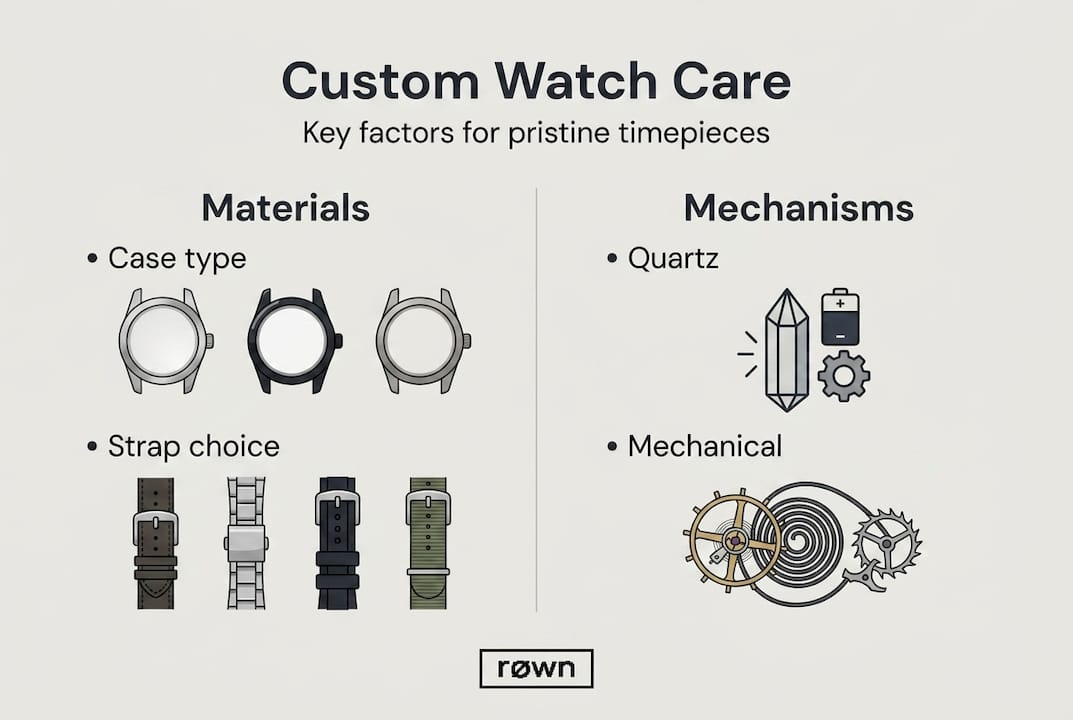
Case and crystal materials
Your watch case is most commonly made from one of the following:
- 316L stainless steel: Highly corrosion-resistant and durable. It can scratch with rough handling but polishes well.
- Titanium: Lighter than steel and hypoallergenic, but more prone to surface scratches. Requires softer care tools.
- PVD-coated steel: A physical vapor deposition (PVD) coating adds color and some scratch resistance, but aggressive cleaning can wear the finish over time.
- Sapphire crystal: Extremely scratch-resistant but can shatter under sharp impact. Mineral glass is softer and more prone to light scratching.
Straps and bracelets introduce even more variables. Leather straps need conditioning to stay supple and must be kept dry. Metal bracelets trap moisture and debris in their links. NATO and rubber straps are far more forgiving but still need regular cleaning to prevent odor or cracking.
Movements: mechanical vs. quartz
The movement inside your watch shapes your entire maintenance routine.
| Feature | Mechanical | Quartz |
|---|---|---|
| Power source | Mainspring (manual or automatic winding) | Battery |
| Accuracy | ±5 to ±10 seconds per day | ±15 seconds per month |
| Service interval | Every 3 to 5 years | Battery replacement every 1 to 3 years |
| Magnetism sensitivity | High | Low to moderate |
| Oil lubrication needed | Yes, internally | Minimal |
Mechanical movements, whether hand-wound or automatic (self-winding), contain dozens of tiny gears and levers that rely on precise lubrication. Without it, parts wear faster and accuracy suffers. Quartz movements are simpler but still need occasional cleaning and battery checks.
Complications and special finishes
Complications, which are features beyond simple hours and minutes, add functional elegance but also care complexity. A chronograph adds pushers that need protection from moisture. A date complication adds a mechanism that can be damaged by aggressive crown manipulation. Skeleton designs, where the dial is partially open to reveal the movement, require more careful handling to avoid introducing dust or debris directly onto the gears.
If you’re still learning how various parts of a build affect your care routine, a review of the customization steps can clarify which components you selected and what each one demands.
Knowing your materials and movement type is not optional knowledge. It directly determines which cleaning tools, storage methods, and service schedules apply to your specific watch.
Routine cleaning practices for lasting brilliance
With materials and mechanisms in mind, proper cleaning becomes your first line of defense.
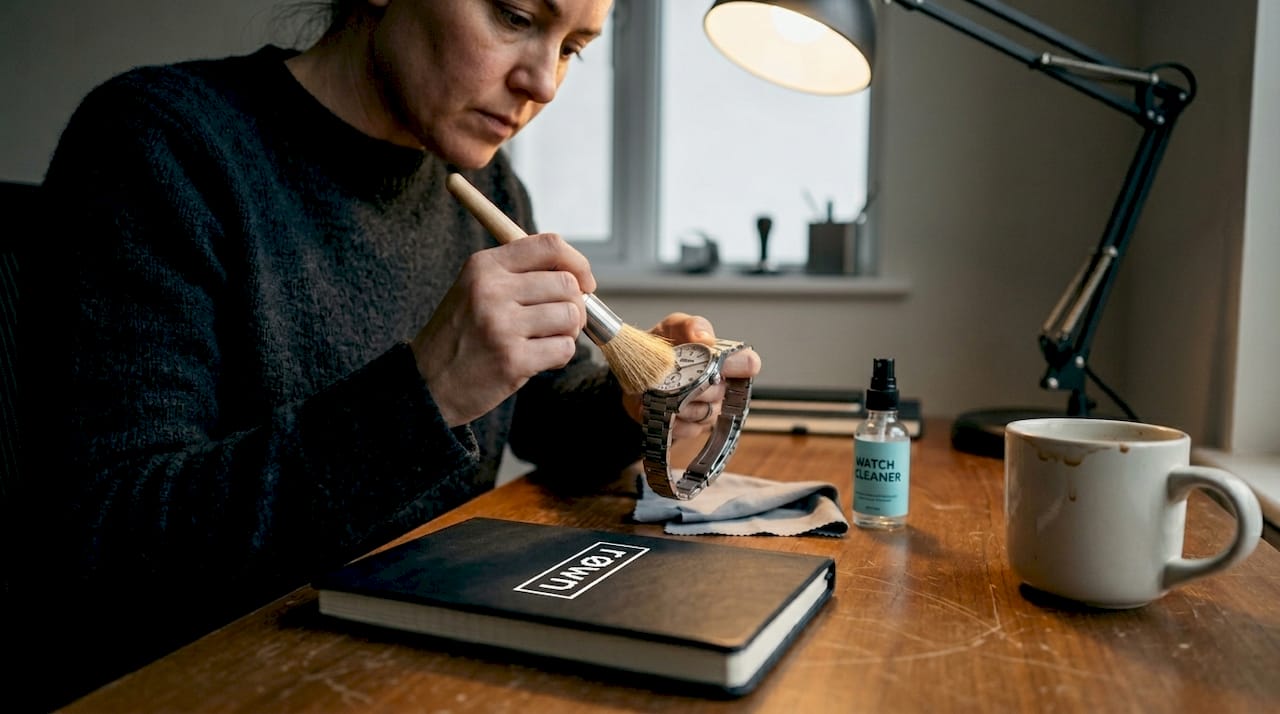
Dirt, sweat, and skin oils accumulate on your watch daily. Left alone, they work their way into crevices, degrade gaskets (the rubber seals that maintain water resistance), and dull the finish. The good news is that cleaning your custom watch does not require specialized equipment. It requires the right tools used in the right way. Watch care practices confirm that consistent, simple routines are what keep custom watches in optimal condition over time.
What you’ll need
Gather these before you start:
- A soft microfiber cloth (never paper towels or rough fabric)
- A soft-bristle brush, such as a new toothbrush or a dedicated watch brush
- Lukewarm distilled water (tap water contains minerals that leave deposits)
- A watch-specific cleaner or a tiny drop of mild dish soap
- A dry lint-free cloth for finishing
Avoid acetone, alcohol-based sprays, or any solvent. These can strip PVD coatings, cloud mineral glass, and degrade rubber gaskets quickly.
Step-by-step cleaning process
- Remove the strap or bracelet if possible. This lets you clean each component properly without spreading moisture into crevices near the case back or crown.
- Wipe the case with a dry microfiber cloth first. This removes loose surface debris before you introduce any moisture.
- Dampen the soft-bristle brush with lukewarm distilled water and add a tiny drop of mild cleaner if needed.
- Gently scrub the case in circular motions, paying attention to the lugs (where the strap attaches) and around the crown and pushers.
- Rinse lightly with a damp clean cloth. Do not submerge the watch unless you have confirmed its water resistance rating and crown is fully tightened.
- Dry immediately and thoroughly with a lint-free cloth, then leave the watch on a clean, dry surface for 15 to 20 minutes before wearing or storing.
- Clean the strap separately. Metal bracelets can be lightly scrubbed with the same brush. Leather straps should only be wiped with a dry or barely damp cloth, then conditioned with a leather product.
For luxury watch personalization enthusiasts who wear their watches daily, a light wipe after each wear and a deeper clean every one to two weeks is a realistic and effective schedule.
Pro Tip: Before any wet cleaning, always push the crown fully in and, if your watch has screw-down crown functionality, lock it securely. This is your single most important step for protecting the movement from moisture.
How often to clean
- After every wear: Dry wipe with a microfiber cloth.
- Every 1 to 2 weeks: Full case and bracelet clean using the steps above.
- Every 3 to 6 months: Detailed clean including strap conditioning and gasket inspection.
Consistency matters far more than effort. A quick two-minute routine after each wear prevents buildup that would otherwise require aggressive cleaning later.
Essential storage and handling tips
Protecting your watch doesn’t stop at cleaning. Safe storage and mindful handling are just as crucial.
Even a perfectly cleaned watch can suffer damage from poor storage. Temperature swings, humidity, magnetic fields, and physical impacts are all daily risks. Knowing how to minimize each one is straightforward once you understand what causes the harm. Industry advice on expert building steps for custom watches consistently highlights storage and handling as areas where new collectors make the most costly mistakes.
Ideal storage conditions
| Condition | Ideal range | What goes wrong outside the range |
|---|---|---|
| Temperature | 59°F to 77°F (15°C to 25°C) | Lubricants thicken in cold; gaskets dry in heat |
| Relative humidity | 40% to 60% | High humidity causes condensation; low causes seal cracking |
| Light exposure | No direct sunlight | UV fades dials and degrades leather straps rapidly |
| Magnetic fields | Away from electronics | Magnetized parts disrupt timekeeping accuracy |
Handling habits that protect your investment
- Remove your watch before contact sports, gardening, or heavy manual work. Even water-resistant watches are not impact-proof.
- Set the watch down face-up or in a dedicated holder, never face-down on a hard surface.
- Avoid placing your watch near phones, tablets, or speaker magnets. Modern mechanical movements with non-anti-magnetic components are vulnerable to even moderate magnetic fields.
- Handle the crown gently. Forcing it in any direction is a leading cause of crown damage and water resistance failure.
- Put your watch on last when getting dressed to avoid exposure to cologne, hairspray, or lotion, all of which degrade seals and finishes faster than most wearers realize.
Watch winders and storage boxes
If you own an automatic watch that you rotate in and out of regular wear, a watch winder can keep it running and ready. A winder mimics wrist motion to keep the mainspring wound. However, not every watch needs or benefits from constant winding. Running a mechanical movement continuously without service actually accelerates internal wear. Use a winder selectively, ideally for watches you plan to wear within the next week.
Pro Tip: Store each watch individually in its own compartment or soft pouch. Storing multiple watches together without separation is the fastest way to cause dial and crystal scratches, even in a padded box.
For travel, a hard-shell watch roll or a case with individual slots is far safer than wrapping in a cloth inside your luggage. Watches stored in checked baggage face pressure changes, rough handling, and temperature swings that can affect both accuracy and mechanical integrity.
Professional servicing and troubleshooting
Even with diligent daily care, some needs call for the hands of a seasoned watchmaker.
No amount of at-home cleaning replaces the work of a trained professional. Inside every mechanical movement are lubricating oils that evaporate and degrade over time. Gaskets compress and lose elasticity. Tiny components accumulate micro-debris that no external cleaning can reach. Branded watch servicing guidance makes clear that extending the life of a quality timepiece depends heavily on scheduled professional maintenance.
Recommended service intervals
- Every 3 to 5 years for mechanical movements. Full service includes disassembly, cleaning of all parts in an ultrasonic bath, replacement of worn components, re-lubrication, and reassembly with accuracy testing.
- Every 1 to 3 years for quartz movements. Battery replacement is the primary task, but the watchmaker should also inspect seals and clean the case interior.
- Immediately if water intrusion is suspected. Do not wait for your next scheduled service. Water inside the movement causes rust and corrosion within hours.
- After any significant impact. Even if the watch appears to be running fine, an impact strong enough to feel can displace components or damage shock absorbers inside the movement.
Signs your watch needs repair now
If your watch is gaining or losing more than 30 seconds per day, showing any fogging under the crystal, producing unusual grinding or clicking sounds, or if the crown feels loose or gritty, stop wearing it and take it to a qualified watchmaker without delay.
These are not minor inconveniences. Each is a symptom of a problem that worsens quickly when the watch continues to run.
What to expect during a professional service
A full mechanical service typically includes inspection, movement removal, ultrasonic cleaning of all parts, replacement of gaskets and worn components, re-lubrication with the correct grade of oil for each component, timing machine testing, and case polishing or brushing if requested. Expect a turnaround of one to four weeks depending on the watchmaker’s schedule and parts availability.
For collectors who have invested in a build using a specific movement, such as an NH35 or ETA 2824, finding a watchmaker familiar with that caliber is worth the extra effort. The annual customization guide is a helpful reference for identifying which movement your watch uses and what its service requirements are.
What not to attempt yourself
Do not open the case back without the proper tools and experience. Do not attempt to adjust timekeeping by manipulating the movement. Do not try to replace gaskets or seals at home. These actions risk damaging movement components, voiding any existing warranty, and compromising water resistance permanently.
A collector’s wisdom: the overlooked keys to custom watch longevity
Here is something that experienced collectors will tell you that most guides leave out: the biggest threat to a custom watch is not accident or neglect. It is inconsistency.
Collectors who maintain heirloom-level watches do not do anything extraordinary. They simply build small habits and stick to them. A wipe after every wear. A storage box that closes properly. A reminder every three years to book a service. That is it.
What new collectors consistently get wrong is treating care as a reactive task rather than a proactive one. They clean only when they notice dirt. They seek service only when something breaks. By then, the damage is already done and the repair bill reflects it.
We also see collectors dramatically underestimate the danger of magnetic exposure. A watch placed on a nightstand next to a charging phone can become magnetized within weeks, causing it to run fast by several minutes a day. This is fixable but entirely preventable.
Finally, do not overlook the value of knowing your watch deeply. Read the deep dive on craftsmanship behind your specific build. When you understand what went into making it, caring for it becomes personal and consistent rather than occasional and reluctant.
Elevate your watch care experience with røwn
If you’re ready to take your collection and care routine to the next level, røwn is the place to start. Our curated selection of bespoke timepieces is built with the same care philosophy covered throughout this guide: quality materials, precise movements, and components chosen to last.
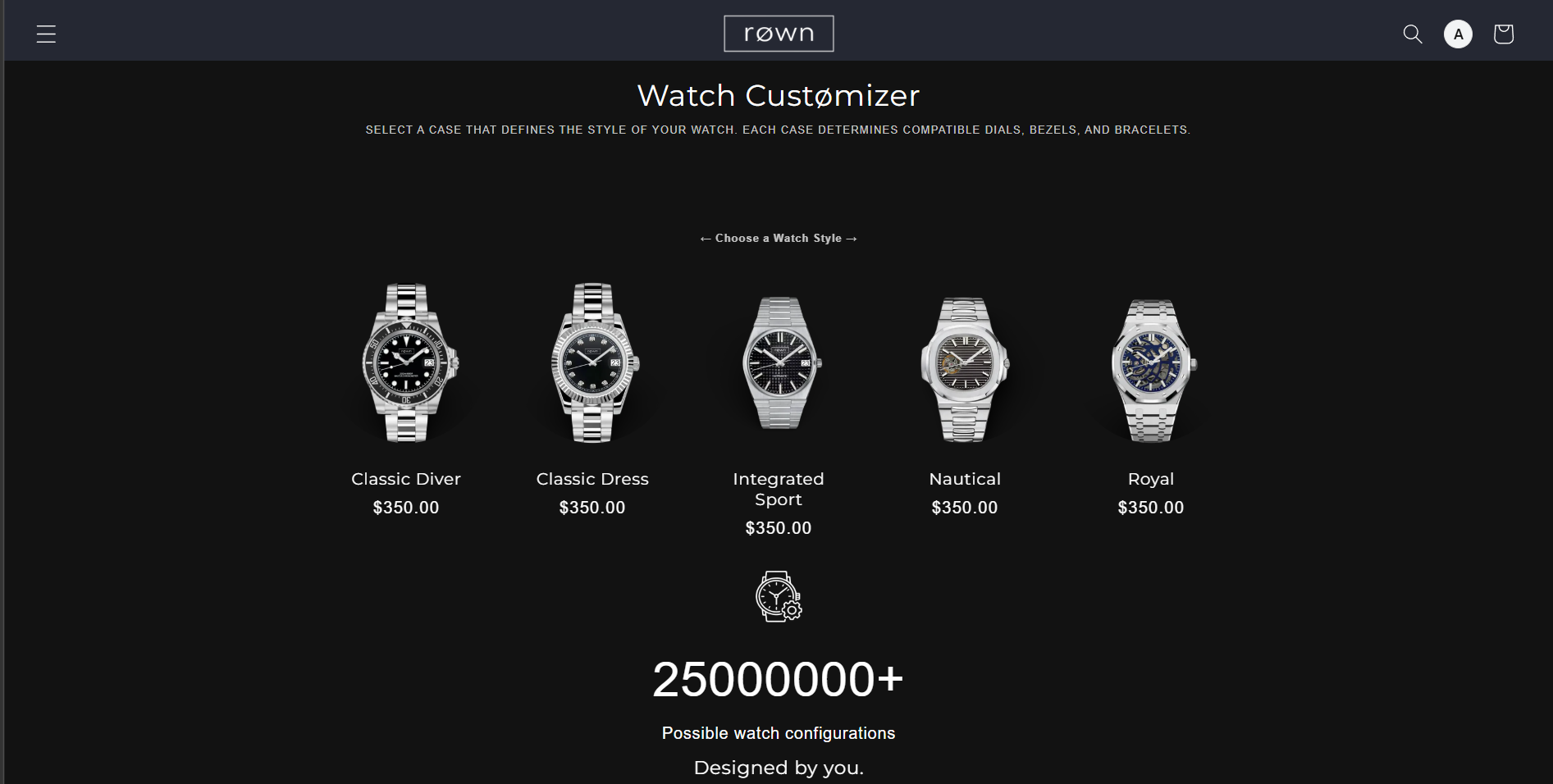
Whether you’re adding a next piece to rotate with your current watch or sourcing a build that prioritizes durability from the ground up, explore our full range of men’s custom watches for inspiration. If you want something performance-focused with a refined aesthetic, the shop Custom Sport collection is an excellent starting point. Our team and educational resources are here to support every decision you make, from the first build to the tenth service.
Frequently asked questions
How often should I service my custom watch?
For most luxury watches, professional servicing every 3 to 5 years ensures optimal performance, as noted in branded watch care guidance across the industry.
What cleaning products are safe for custom watch cases?
Use a microfiber cloth, soft brush, and watch-specific cleaner. Avoid harsh chemicals that can strip finishes or compromise seals, following established care practices for custom timepieces.
Can I use a watch winder with all custom watches?
A watch winder is only necessary and safe for automatic (self-winding) movements. Check your watch component specs to confirm your movement type before using one.
What’s the best way to store my custom watch collection?
Store watches in a cool, dry environment between 59°F and 77°F, in individual compartments or soft cases to prevent scratches, as recommended in expert storage advice for custom builds.
How do I know if my custom watch needs repair?
Look for signs like time inaccuracies exceeding 30 seconds per day, condensation under the crystal, or unusual sounds, and consult a qualified watchmaker promptly. Industry servicing guidance advises acting quickly rather than waiting for a scheduled service.