

TL;DR:
- Choosing compatible components and verifying measurements prevents damage and ensures proper fit.
- The movement is the most crucial part affecting accuracy, maintenance, and overall quality.
- Building a watch that reflects personal story and intentional choices adds lasting value and meaning.
One wrong component can unravel an entire custom watch build. You might spend hours researching dials and cases, only to find that your strap clashes with your bezel or your movement doesn’t fit your case diameter. That frustration is more common than you’d think, and it’s completely avoidable. This guide walks you through every major component, how to evaluate it, and how to make choices that work together as a unified design. When you understand what each part does and why it matters, your finished watch doesn’t just keep time. It tells your story.
Table of Contents
- What makes up a luxury watch? Key components overview
- Essential prep: Matching watch style to your lifestyle
- How to evaluate and select each component
- Avoiding common mistakes and troubleshooting component issues
- The final check: Testing and enjoying your completed watch
- What most guides miss: The art behind practical watch selection
- Design your custom watch with røwn
- Frequently asked questions
Key Takeaways
| Point | Details |
|---|---|
| Component basics | Know the main parts of a watch to make smart selection choices for your custom build. |
| Align with lifestyle | Base your component choices on how and where you intend to wear your watch for lasting satisfaction. |
| Evaluate each part | Use specific criteria for movement, case, dial, hands, and strap to match performance and style. |
| Verify compatibility | Ensure all selected components work together before final assembly to avoid damage or disappointment. |
| Inspect the result | Carefully test your finished watch for accuracy and comfort to ensure it meets your vision. |
What makes up a luxury watch? Key components overview
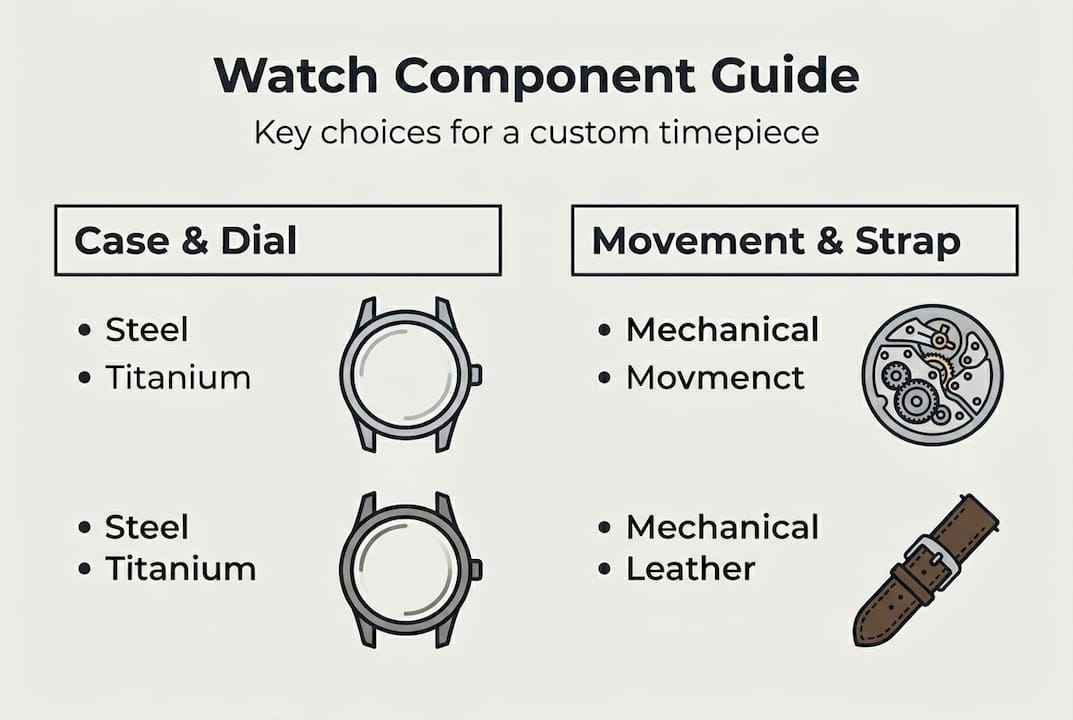
Now that you’re committed to designing your ideal watch, you need to know what parts you’ll actually be choosing. Watch component basics cover six core elements, and each one affects both the look and the performance of your finished piece.
Here’s a quick breakdown of each component:
- Movement: The engine of the watch. It determines accuracy, power reserve, and maintenance frequency. Automatic movements wind themselves through wrist motion, while manual movements require daily winding.
- Case: The outer shell that houses the movement. It sets the overall size, shape, and water resistance level of the watch.
- Dial: The face of the watch. It’s the most visible design element and the one most people notice first.
- Hands: They point to the time and contribute heavily to readability and style. Options range from minimalist stick hands to ornate sword or cathedral styles.
- Crystal: The protective cover over the dial. Sapphire crystal is scratch-resistant; mineral crystal is more affordable but less durable.
- Strap or bracelet: How the watch sits on your wrist. Material and fit directly affect daily comfort and overall aesthetic.
Understanding the roles of movement, case, dial, hands, and strap is essential for both quality and style. Here’s a quick reference to compare your main material options:
| Component | Common options | Key advantage |
|---|---|---|
| Case | Stainless steel, titanium, PVD-coated | Durability, weight, finish |
| Crystal | Sapphire, mineral, acrylic | Scratch resistance vs. cost |
| Strap | Leather, rubber, stainless bracelet | Comfort, style, water resistance |
| Dial | Sunburst, matte, skeleton, enamel | Visual personality |
| Movement | NH35, ETA 2824, Miyota 9039 | Accuracy, serviceability |
Your personal style and practical needs shape every one of these choices. A diver build calls for different materials than a dress watch.
Essential prep: Matching watch style to your lifestyle
Once you know the parts, the next step is making sure the total look fits your actual life. A watch’s design should reflect both everyday function and special occasions, and that balance starts before you select a single component.
Work through this checklist before you start shopping:
- Define your primary use case. Will this watch go to the office, the gym, the ocean, or formal events? Each context demands different materials and specifications.
- Identify your color palette. Do you prefer warm tones like gold and cognac leather, or cool tones like brushed steel and navy? Consistency across components creates a cohesive result.
- Set your uniqueness threshold. Some builders want a one-of-a-kind statement piece. Others want something refined and wearable every day. Know where you fall.
- Establish a budget range per component. Movement and case tend to be the largest costs. Knowing your limits prevents overspending on dial details at the expense of movement quality.
- List any must-have features. Water resistance rating, date complication, lume (luminescent coating on hands and markers), or hacking seconds are all worth deciding on early.
Pro Tip: Start with one signature element that expresses your personality, whether that’s a striking sunburst dial or a sapphire caseback that shows off the movement, and then build the remaining components around it. This keeps the design cohesive without overcomplicating the process.
If you’re still exploring what resonates with your aesthetic, personalizing your watch and reviewing a luxury style guide can help you narrow your preferences quickly.
How to evaluate and select each component
With your style and needs clear, it’s time to examine how each component stacks up before you commit. Here’s what to focus on for each major part.

Movement: Movement choice affects accuracy and maintenance more than any other component. The NH35A from Seiko is the most popular for custom builds due to its reliability, hacking seconds feature, and hand-windable design. The Miyota 9039 runs quieter and is a solid runner-up. If you want ultra-precision, ETA-based movements offer Swiss finishing at a higher price point.
Case: Evaluate diameter (36mm to 44mm covers most wrists), lug width, and case thickness. Thicker cases accommodate more complex movements but can feel bulky on smaller wrists.
Dial, hands, and strap: Different dials, hands, and straps directly elevate the uniqueness and value of your watch. Look for these features when comparing:
- Dial finish: sunburst vs. matte vs. textured
- Hand style: dauphine, pencil, sword, skeleton
- Lume quality and color (BGW9 for blue, C3 for green)
- Strap material: leather thickness, rubber compound, bracelet taper
- Clasp type: tang buckle vs. deployant for security
For deeper research on specific options, explore watch movement types, unique watch dials, how to customize watch hands, and custom strap choices.
Pro Tip: Prioritize reliability and compatibility over flashy add-on features. A movement that services easily in five years is worth more than a complication you’ll rarely use.
| Component | Budget option | Premium option | Key difference |
|---|---|---|---|
| Movement | Miyota 8215 | NH35A / ETA 2824 | Accuracy, serviceability |
| Crystal | Mineral | Sapphire (AR-coated) | Scratch resistance |
| Case | 316L steel | 904L steel / titanium | Corrosion resistance, weight |
Avoiding common mistakes and troubleshooting component issues
Even with the right information, it’s easy to make avoidable mistakes. Here’s how to sidestep the biggest issues.
Warning: Mixing incompatible components can damage your watch and void warranties. Always verify lug width, dial stem hole diameter, and movement pillar dimensions before purchasing.
The most common mistakes builders make:
- Wrong lug width on the strap. If your case has 20mm lugs and you order a 22mm strap, it won’t fit. Always measure twice.
- Mismatched dial foot spacing. Dial feet must align with the movement’s dial post holes. This varies between movement brands and is often overlooked.
- Ignoring water resistance ratings. A 3 ATM case paired with a rubber diver strap creates a confusing mismatch and false expectations. Align resistance ratings with your actual use.
- Skipping compatibility verification on hands. Hand tube diameter must match the movement’s cannon pinion. Incorrect sizing causes hands to sit off-center or fall off entirely.
- Overlooking caseback thread compatibility. If you’re sourcing the case and movement separately, confirm the caseback fits the case body before assembling.
If you’ve already made a mistake, stop before forcing parts together. Forced assembly can scratch the movement, crack the dial, or strip the caseback threads. Refer to custom watch assembly guides or contact a trusted builder service to assess the damage before proceeding.
The final check: Testing and enjoying your completed watch
Once your watch is assembled, don’t forget the crucial last step: thorough inspection and test-wearing.
A final inspection ensures long-term reliability and personal satisfaction. Work through this post-build checklist before calling it done:
- Accuracy test. Wear the watch for 48 to 72 hours and compare it against a time reference. Most automatic movements should run within plus or minus 15 seconds per day.
- Crown and stem function. Pull the crown to each position (winding, time-setting, date-setting if applicable) and confirm smooth engagement without slipping.
- Hand alignment. At the 12 o’clock position, check that the minute and hour hands align precisely with the 12 marker. Misalignment signals a fitting issue.
- Comfort and fit check. Wear the watch for a full day. Note any pressure points on the strap, case edge sharpness on the wrist, or clasp irritation.
- Lume inspection. Charge the dial under a light source and verify that all indices and hands glow evenly. Uneven lume often signals poor application.
- Water resistance test. If your case is rated for water exposure, test it at or below its rated depth using a pressure tester before wearing it near water.
Schedule your first service after three to five years. Even reliable movement reliability degrades without periodic cleaning and lubrication. Staying ahead of servicing protects your investment and keeps the watch performing as intended for decades.
What most guides miss: The art behind practical watch selection
Most watch-building guides stop at specs. They’ll tell you which movements are accurate and which crystals scratch less. That’s useful, but it’s only half of the picture.
The reason bespoke watches hold such lasting appeal is that every component carries a decision. And decisions, when made with intention, carry meaning. The dial color you chose because it matched something personal, the lume you picked because you read once that astronauts used it—those details make a watch yours in a way that no catalog item ever can.
We believe that building your own watch is as much about self-expression as it is about horology. When you treat selection as both science and art, the result is a watch that performs well and means something. The most treasured timepieces aren’t always the most expensive. They’re the ones where every component was chosen on purpose, with care, and with the wearer’s story in mind. That’s the standard worth chasing.
Design your custom watch with røwn
Ready to bring your vision to life? Røwn makes choosing and assembling top-quality components straightforward and genuinely enjoyable.
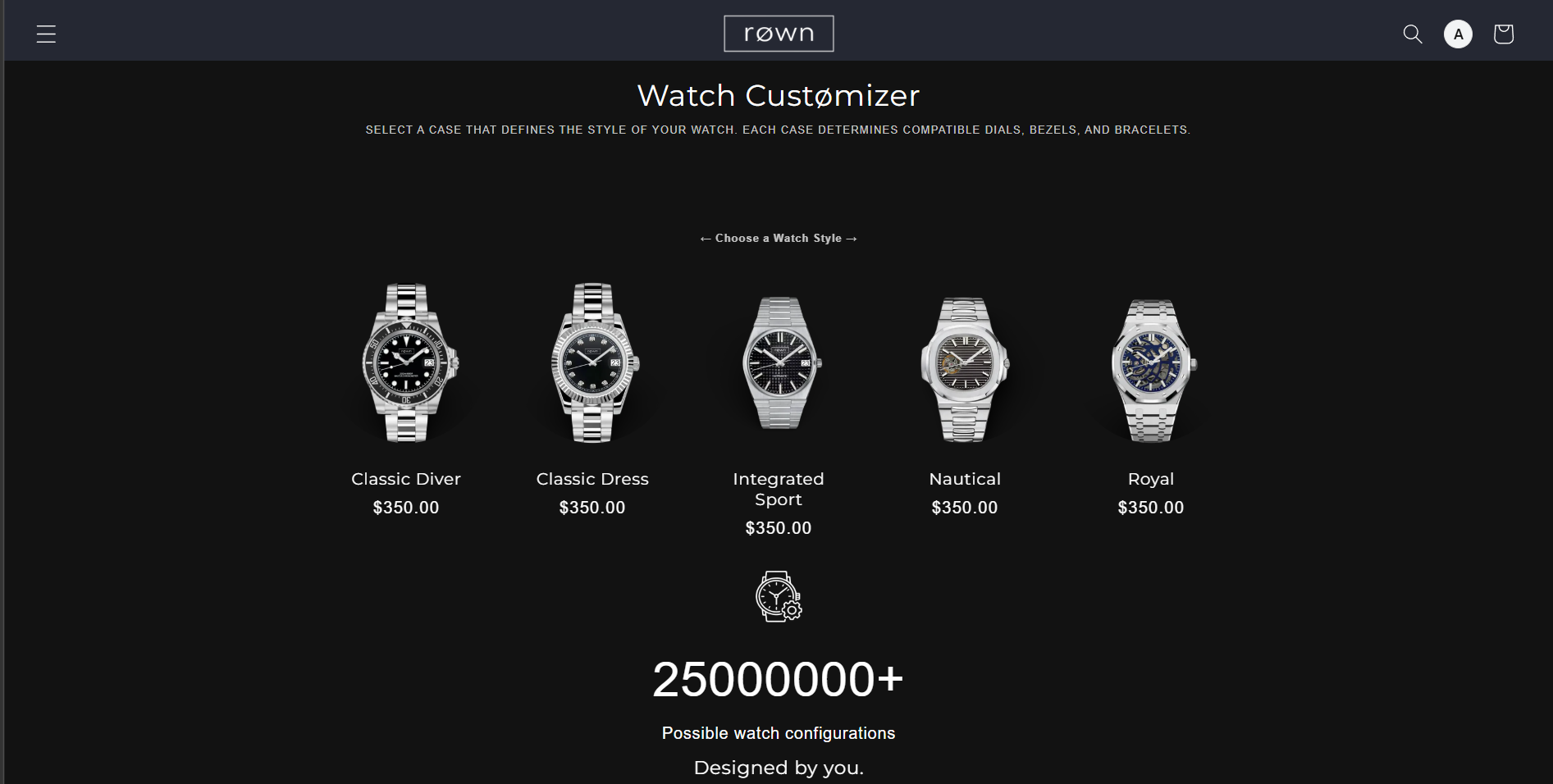
At røwn, you select from a curated range of movements, cases, dials, hands, and straps, all verified for compatibility. Whether you want to explore men’s watches, start with a ready-to-customize custom diver build, or explore women’s watches with refined finishing options, the platform walks you through each step. Every component ships free, and røwn’s high customer rating reflects the care built into every order. Your ideal watch is closer than you think.
Frequently asked questions
What is the most important watch component to choose first?
Start with the movement, as movement choice affects accuracy and maintenance needs, and it determines which cases and dials will be compatible with your build.
How can I tell if watch components are compatible?
Check all measurements and manufacturer specifications carefully, because mixing incompatible components can lead to malfunction or void your warranty entirely.
Does material choice impact the value of a custom watch?
Yes, premium materials like sapphire crystal and stainless steel increase durability and resale value, since understanding materials is key to creating a lasting, valuable timepiece.
Can I swap out components later if my tastes change?
Most straps and some dials can be swapped relatively easily, but certain parts lend themselves to later customization more than others, and movement or case changes are significantly harder after full assembly.