

TL;DR:
- Finishing techniques like black polishing and Zaratsu significantly enhance a watch’s visual appeal and value.
- Skilled application of finishing methods requires proper tools, a clean workspace, and careful inspection.
- Judgment and restraint in finishing decisions create contrast and authenticity, distinguishing high-quality custom watches.
Finishing is what separates a custom watch that turns heads from one that simply tells time. You can choose premium components, source a quality movement, and nail every measurement, but without precise, intentional surface finishing, a timepiece will always look a step short of extraordinary. This guide covers the most important finishing methods used in watchmaking, from black polishing to Zaratsu, along with the tools, setup, step-by-step execution, and quality control practices that make the difference. Whether you’re building your first custom piece or refining your process, understanding finishing gives you real control over how your watch looks, feels, and holds its value over time.
Table of Contents
- Understanding custom watch finishing: Techniques and significance
- Essential tools and preparation for custom finishing
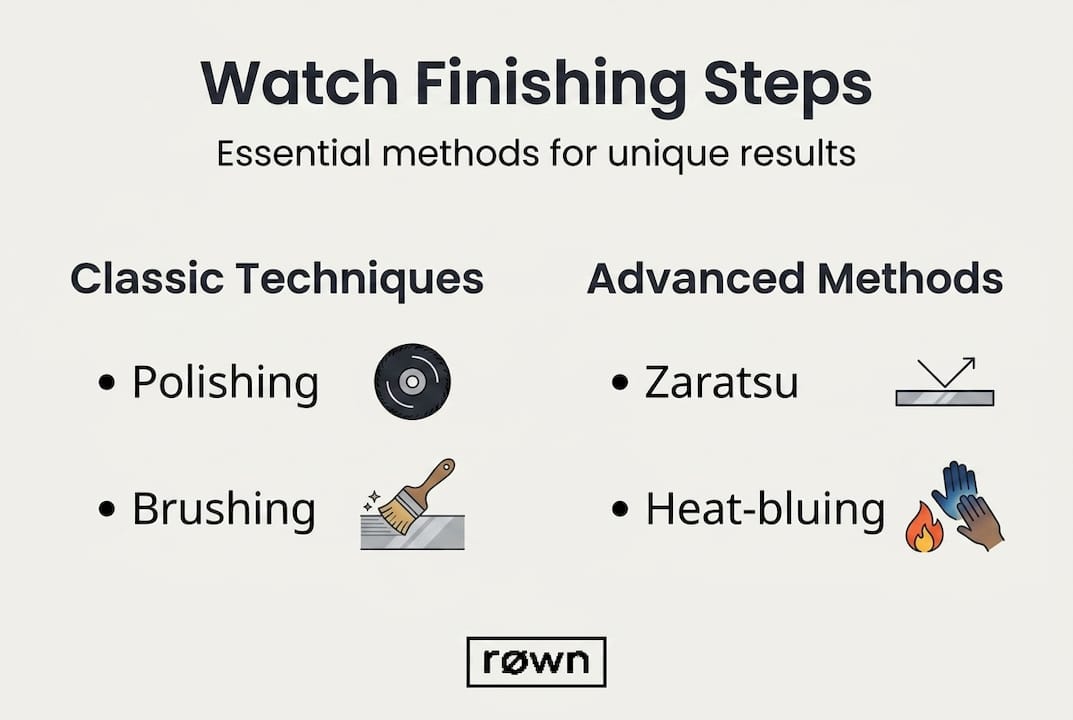
- Step-by-step: Applying classic and advanced watch finishing methods
- Quality control: How to evaluate and maintain custom finishes
- Why finishing expertise—not just technique—defines collectible custom watches
- Elevate your next custom timepiece with professional finishing
- Frequently asked questions
Key Takeaways
| Point | Details |
|---|---|
| Finishing defines value | Superior finishing directly impacts a watch’s appeal and long-term worth for collectors and enthusiasts. |
| Preparation is crucial | Successful results depend on using the right tools, workspace, and technique tailored to each finishing method. |
| Technique and restraint | Knowing when to stop and understanding each method’s demand is just as important as skill in creating authentic results. |
| Inspect and protect | Careful inspection and regular maintenance help preserve the beauty and value of custom-finished timepieces. |
Understanding custom watch finishing: Techniques and significance
Finishing, in watchmaking, refers to the surface treatment of metal components. It controls how light interacts with a part, how resistant it is to corrosion, and how it reads to a trained eye. For collectors and enthusiasts, finishing is not decorative afterthought. It’s a core part of a watch’s identity and value.
Most finishing methods fall into two categories: polishing (creating reflective surfaces) and brushing or anglage (creating matte or directional textures). Skilled finishers often combine both on a single component, playing contrasting textures against each other for visual depth.
The most valued finishing techniques include:
- Black polishing: The most demanding technique in watchmaking. Black polishing creates a mirror-like surface using diamond pastes ranging from 400 to 20,000 grit on pewter or zinc plates with circular motions. At certain angles, the surface appears almost black due to light absorption, hence the name. It also reduces oxidation. The catch is that any tiny scratch becomes immediately visible, making this a true test of skill.
- Heat-bluing: Steel parts, typically hands or screws, are polished to a mirror finish and then carefully heated to a specific temperature to produce a vivid blue color. It’s visually dramatic and adds corrosion resistance.
- Zaratsu polishing: Developed and most famously used by Grand Seiko, this is an industrial-level black polishing technique applied by hand to produce completely distortion-free mirror surfaces on cases and hands.
- Côtes de Genève (Geneva stripes): Parallel lines applied to movement bridges and plates, mainly decorative but a sign of care.
- Perlage: Small circular patterns applied to hidden surfaces, visible only when a case is opened. A sign of thorough craftsmanship.
| Technique | Surface result | Difficulty | Best used on |
|---|---|---|---|
| Black polishing | Mirror, near-black at angles | Very high | Screws, bridges |
| Heat-bluing | Vivid blue mirror | High | Hands, screws |
| Zaratsu polishing | Distortion-free mirror | Very high | Cases, hands |
| Côtes de Genève | Parallel stripe texture | Medium | Bridges, plates |
| Brushing | Matte directional grain | Low to medium | Case sides, lugs |
The hand vs. machine debate is central to how collectors evaluate custom pieces. Machines produce uniform results but lack organic variation, while hybrids like rotary tools can mimic hand finishing but are detectable under a loupe. More critically, over-polishing rounds edges and thins lugs, which directly reduces a watch’s collectible value. For anyone serious about custom watches craftsmanship, this distinction matters enormously.
“The difference between a professionally finished watch and a passable one is invisible at a glance and undeniable under a loupe.”
Quality finishing also protects against corrosion, improves component longevity, and signals genuine horological care. A poorly finished screw or bridge undermines the entire movement’s appearance when a case is opened. Done well, finishing signals that every decision in a build was intentional.
Essential tools and preparation for custom finishing
Theory sets the direction, but execution depends on your tools and your workspace. Before you apply a single drop of diamond paste, your setup needs to be right.
Core tools by technique:
| Tool / Material | Used for | Grit / Spec |
|---|---|---|
| Diamond lapping paste | Black polishing, Zaratsu | 400 to 20,000 grit |
| Pewter or zinc plate | Black polishing base surface | Flat and true |
| Alcohol lamp or torch | Heat-bluing | Controlled flame |
| Copper or brass plate | Heat-bluing even distribution | Thin gauge |
| Watchmaker’s loupe | Inspection | 5x to 10x magnification |
| Lint-free gloves | All techniques | Cotton or nitrile |
| Pith wood sticks | Buffing and manipulation | Natural pith |
| Brass pegwood | Holding parts | Custom-cut |
| Degreaser / isopropyl alcohol | Pre-cleaning surfaces | 99% purity |
| Timing machine (optional) | Post-build verification | Standard beat rate |
Workspace setup matters as much as the tools. Dust and humidity are enemies of finishing. Work in a clean, enclosed area. A watchmaker’s mat over a flat, stable surface is standard. Close windows during sessions to limit airborne particles. Even a single dust grain under a polishing plate can leave a scratch that requires starting over.

Material selection is equally critical. Not all steel is created equal. For black polishing, you want hardened steel with a fine grain structure. Softer steel won’t hold the finish and scratches too easily. When sourcing components, check for surface cleanliness, any prior machining marks, and whether the steel has been heat-treated.
Key preparation steps:
- Degrease all parts thoroughly with 99% isopropyl alcohol before starting
- Inspect surfaces under loupe for pre-existing scratches, pitting, or machining lines
- Ensure your lapping plate is perfectly flat using a surface gauge if possible
- Prepare diamond paste in sequential grits and keep them clearly labeled
- Wear gloves from the moment you pick up a clean part
Pro Tip: Always test your polishing technique on a less-visible surface segment, such as the underside of a lug or an extra scrap part, before working on the primary display surface. This reveals how the steel responds to your paste and pressure so you can adjust before it counts.
When you build your own watch, finishing preparation is one of the steps that separates a clean final result from one you’ll want to redo. Reviewing watch customization steps ahead of time helps you plan finishing into the build sequence rather than treating it as an add-on.
Step-by-step: Applying classic and advanced watch finishing methods
With your workspace clean and tools ready, you can follow the process for each major finishing technique. Each method demands its own approach and mindset.
Black polishing
- Start at the lowest grit, typically 400, with a small amount of diamond paste on your pewter or zinc plate.
- Apply the part to the plate with even, circular motions. Keep pressure consistent and moderate. Uneven pressure creates uneven finish.
- Progress through grits sequentially, from 400 to 1,200 to 3,000 to 6,000 and finally to 14,000 or 20,000. Clean the part and plate between each grit to avoid cross-contamination.
- Inspect at each stage under your loupe. Any scratch visible at a lower grit must be eliminated before moving up. Do not rush this step.
- At the final grit, the surface should appear mirror-bright and nearly black when held at a shallow angle to light. This is the characteristic optical effect of true black polishing.
Heat-bluing
Heat-bluing relies on precise temperature control. Mirror-polished steel is heated to specific temperatures to achieve the blue hue on hands and screws, with flame-blued parts also showing better corrosion resistance.
- Polish the steel part to a mirror finish first. The blue color will only look clean and even on a flawless base surface.
- Place the part on a copper or brass heating plate over your alcohol lamp or controlled flame source.
- Apply heat gradually and evenly. Steel passes through yellow, brown, purple, and blue as temperature rises. Remove at the correct blue stage, typically around 295 to 310 degrees Celsius.
- Allow to cool naturally. Do not quench. Any contact during cooling can disturb the oxide layer.
- Inspect for even color distribution. Uneven heating shows as streaks or color bands.
Zaratsu polishing
Zaratsu is an industrial black polishing method used famously by Grand Seiko for distortion-free mirror surfaces, guided entirely by hand for perfection.
- Secure the case or component firmly without marring adjacent surfaces.
- Use a felt or leather wheel with the appropriate lapping compound.
- Guide the part by hand across the wheel, maintaining consistent angle and pressure. The hand-guided motion is what creates the distortion-free result that machines cannot replicate.
- Work in stages, checking under loupe between passes for any distortion or streaking.
Pro Tip: Environmental controls matter more than most beginners expect. Even minor humidity can affect how diamond paste behaves on a plate, and a single draft across your workspace can deposit enough dust to ruin a final-stage black polish. Work in short, focused sessions rather than long ones.
When customizing watch hands or other custom watch components, finishing decisions for each part should be mapped out before you start. Mixing polished and brushed surfaces strategically creates contrast that elevates the overall design.
“Rounding even one edge during over-polishing changes the character of a case permanently. Collectors notice. You cannot un-do it.”
Quality control: How to evaluate and maintain custom finishes
Finishing applied is not finishing verified. Thorough inspection is the step most beginners skip, and it’s the one that determines whether your work is genuinely complete.
Inspection checklist:
- Scratch check: Inspect all polished surfaces under a 10x loupe in strong directional light at multiple angles. Even a single fine scratch on a black-polished surface disqualifies it.
- Edge integrity: Check that edges are still crisp and well-defined. Over-polishing rounds edges and thins lugs, which is immediately detected by collectors and reduces value.
- Color uniformity (heat-blued parts): Hold hands and screws against white paper. The blue should be consistent across the full surface with no streaking or banding.
- Reflection quality (mirror surfaces): A good black polish or Zaratsu surface should show your reflection without distortion. Tilt the part slowly. Any waviness in the reflection means the surface isn’t flat.
- Surface cleanliness: No fingerprints, dust, or residue. Reclean with isopropyl alcohol and dry lint-free before final inspection.
Maintenance tips to preserve your finish:
- Store finished components in sealed, acid-free containers when not assembled
- Avoid touching polished surfaces with bare hands; oils accelerate oxidation
- For assembled watches, clean with a soft microfiber cloth to prevent micro-abrasion
- Consider a protective coating on brushed surfaces exposed to everyday wear
- Schedule periodic professional cleaning if the watch is worn daily
| Finish type | Maintenance frequency | Professional service needed? |
|---|---|---|
| Black polished parts | Inspect annually | Yes, if scratched |
| Heat-blued screws/hands | Check every 2 to 3 years | Yes, for rebluing |
| Brushed case surfaces | Clean monthly | No, DIY-friendly |
| Zaratsu case surfaces | Inspect every 2 years | Yes, specialized tools |
Knowing when to handle it yourself versus calling in a professional finisher is an important judgment call. If you’re seeing fine haze on a black-polished bridge or slight discoloration on a heat-blued hand, a professional with the right plates and paste can restore it cleanly. For personalized watch expert steps, understanding when to refer to a specialist is part of the craft. As you personalize luxury automatic watches, building a relationship with a qualified finisher is a long-term investment worth making.
Why finishing expertise—not just technique—defines collectible custom watches
Here is the part of finishing that most guides won’t say directly: knowing how to execute a technique is not the same as knowing when to use it or when to stop.
The watch world has seen finishing become something of a status signal. Hand finishing is increasingly treated as a complication in itself, with some microbrands advertising it to justify prices without the depth of craft to support the claim. The lack of consistent benchmarks means that a label of “hand-finished” can mean almost anything.
The real distinction lies in restraint. An overzealous finisher can drain all the character out of a case by polishing every surface to the same mirror brightness. The contrast between textures is what creates visual interest and authenticity. A custom watch that has been finished with judgment, not just skill, shows it. Luxury branded watches achieve this through decades of trained craft. For custom builders, achieving it requires asking not just “can I do this?” but “should I do this here?”
Finishing expertise is ultimately about proportion, context, and intention. The most skilled finishers know when a brushed surface serves better than a mirror, when one polished screw adds accent rather than noise, and when to leave well enough alone.
Elevate your next custom timepiece with professional finishing
Custom finishing isn’t just a skill set. It’s an expression of what you value in a watch. A well-finished timepiece rewards the owner with detail that reveals itself slowly over time, a surface quality that holds up to close inspection and everyday wear alike.

At Røwn, you can explore men’s custom watches and women’s custom watches that demonstrate professional finishing across dials, cases, and hands. If you want to see how a fully realized build comes together in one piece, the custom diver watch is a strong example of how component selection and surface finishing work together to create a watch that is genuinely your own. Browse the build options and see what your next timepiece could look like.
Frequently asked questions
What is black polishing and why is it used in watches?
Black polishing creates a mirror-like finish on steel parts using diamond pastes from 400 to 20,000 grit, reducing oxidation and creating a distinctive near-black appearance at certain angles. It is valued for its exceptional difficulty and the precision it demands from the finisher.
How does heat-bluing differ from other decoration methods?
Unlike polishing or brushing, heat-bluing uses controlled heat to produce a vivid blue color on mirror-polished steel hands and screws, while also improving corrosion resistance. The result is both decorative and functional, making it one of the most respected finishes in watchmaking.
Why is over-polishing harmful to watch cases?
Over-polishing rounds edges and thins lugs on watch cases, permanently altering their geometry and reducing collectible value in a way that cannot be reversed. Collectors with loupes notice this immediately, and it is one of the most common errors made by inexperienced finishers.
What finishing method does Grand Seiko use for its mirror surfaces?
Grand Seiko uses Zaratsu polishing, an advanced hand-guided technique derived from industrial black polishing that produces completely distortion-free mirror surfaces on cases and hands with no machine-introduced inconsistencies.
Can microbrands achieve high-end finishing at lower prices?
Some microbrands advertise hand finishing, but industry skepticism about the actual quality remains high given the lack of established benchmarks and the significant labor involved in genuine hand-finishing work. Evaluating claims requires close inspection under magnification rather than taking marketing language at face value.